How to Spot Fake Discounts in Singapore

A fake discount is one where the 'usual price' was inflated or never genuinely charged, so the headline percentage is measured against a number that was never real. CCCS guidance says any comparison must use a bona fide previous price.
On this page (4 sections)
The loudest number in any sale is the percentage off. But “70% off” only means something if the price it is measured against is real. A fake discount is one where the “usual” or “before” price was inflated, or was never genuinely charged. Here is how to spot one — and what the rules in Singapore actually say.
What the rules say
Singapore’s Competition and Consumer Commission (CCCS) publishes price-transparency guidelines that interpret the Consumer Protection (Fair Trading) Act (CPFTA). On discounts and strike-through pricing, the guidance is clear:
- A “usual price” used in a comparison should be a genuine (bona fide) previous price.
- It must not be a price the retailer never actually offered, or one offered only for an insignificant period just before the “sale”.
- Time-limited discounts should state the period clearly.
The Singapore Code of Advertising Practice adds that a discounted price must be genuinely lower than the usual price and cannot be offered indefinitely — if the “discount” price becomes the normal price, it is no longer a discount. In short, a dressed-up markdown can breach these standards.
Five checks before you trust a markdown
- Know the baseline. Note the item’s everyday price a week or two before the sale. This is your single best defence.
- Watch the “before” price. If the strike-through figure jumped up shortly before the campaign, be sceptical.
- Compare across platforms. Check the same item on Shopee and Lazada, including vouchers and shipping.
- Ignore the countdown. Artificial urgency is designed to stop you checking. A genuine price survives a five-minute pause.
- Count the true cost. Compare the final checkout total, including delivery and any GST shown. For imported low-value goods, check whether GST was already collected by the supplier or marketplace rather than adding another 9% yourself.
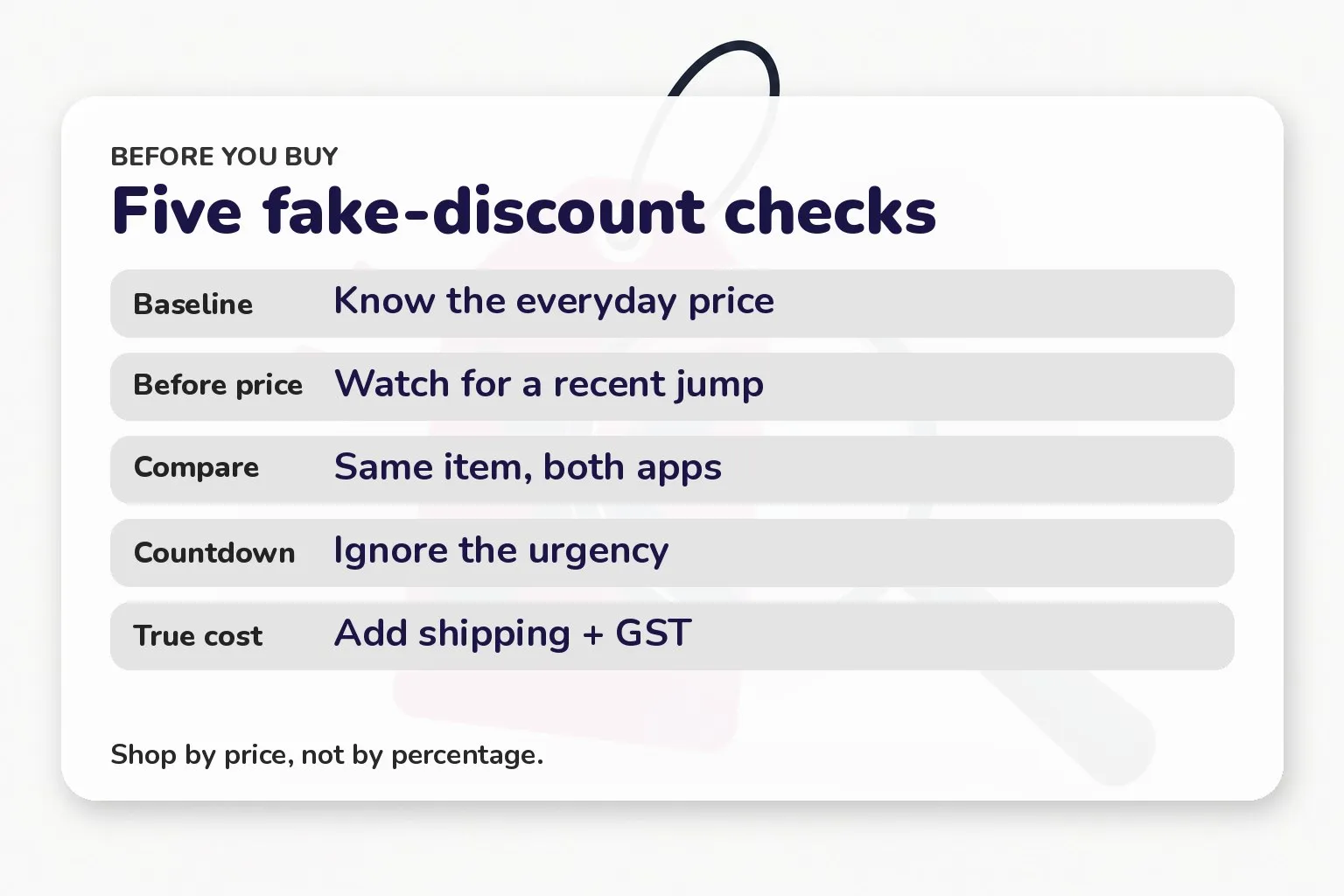
Consumer-side checks aligned with CCCS price-transparency guidance, 2020.
Our price tracking adds one more input: whether the current price is below the typical level we have recorded over time. To turn a claimed markdown into a real percentage and a true checkout cost, use our discount checker.
If you think a discount is misleading
You can report a potentially misleading price claim to the Consumers Association of Singapore (CASE), the first point of contact for consumers, and your protections against unfair practices sit under the CPFTA, administered by CCCS. Keep a screenshot of the price claim and the date.
The bottom line
Don’t shop by percentage — shop by price. Learn an item’s real everyday cost, treat strike-through “usual prices” with healthy suspicion, and only buy when the genuine out-the-door figure is the lowest you have seen. Then the sale is working for you, not on you. For a worked example during a specific event, see the 11.11 guide.
Sources
- CCCS Publishes Guidelines on Price Transparency — Competition and Consumer Commission of Singapore (as of September 2020)
- About Fair Trading Practices (CPFTA) — Competition and Consumer Commission of Singapore (as of October 2026)
- CPFTA & Lemon Law — Consumers Association of Singapore (CASE) (as of October 2026)
- Singapore Code of Advertising Practice (SCAP) — Advertising Standards Authority of Singapore (ASAS) (as of October 2026)