How Our Price Tracking Works (and Its Limits)
We record prices only from official affiliate APIs (Shopee and Lazada via Involve Asia) and store them over time to build our own series. It is our tracking, not the seller's price history, it is not scraped, and prices change constantly, so always confirm on the seller's page.
On this page (5 sections)
A lot of “price history” tools make confident claims about what a product used to cost. We are deliberately more modest, because being honest about where our data comes from matters more than looking all-knowing. Here is exactly how our tracking works — and what it cannot do.
Where the data comes from
We pull prices and offers only from official affiliate APIs: the Shopee Affiliate Programme and Lazada via Involve Asia. These are sanctioned data feeds that return a product’s current price and an official link.
We do not scrape seller pages. Scraping would breach the platforms’ terms, and it produces unreliable data. Using the official APIs keeps us compliant and keeps the numbers trustworthy.
It is our record, not the seller’s history
This is the most important point. When we show a price over time, that line is our own series — the values we recorded each time we queried the API. It is not the seller’s internal price history, which we have no access to.
So if we started tracking an item three weeks ago, our chart starts three weeks ago. We will never pretend to know a price from before we began recording it.
What we can and cannot tell you
We can:
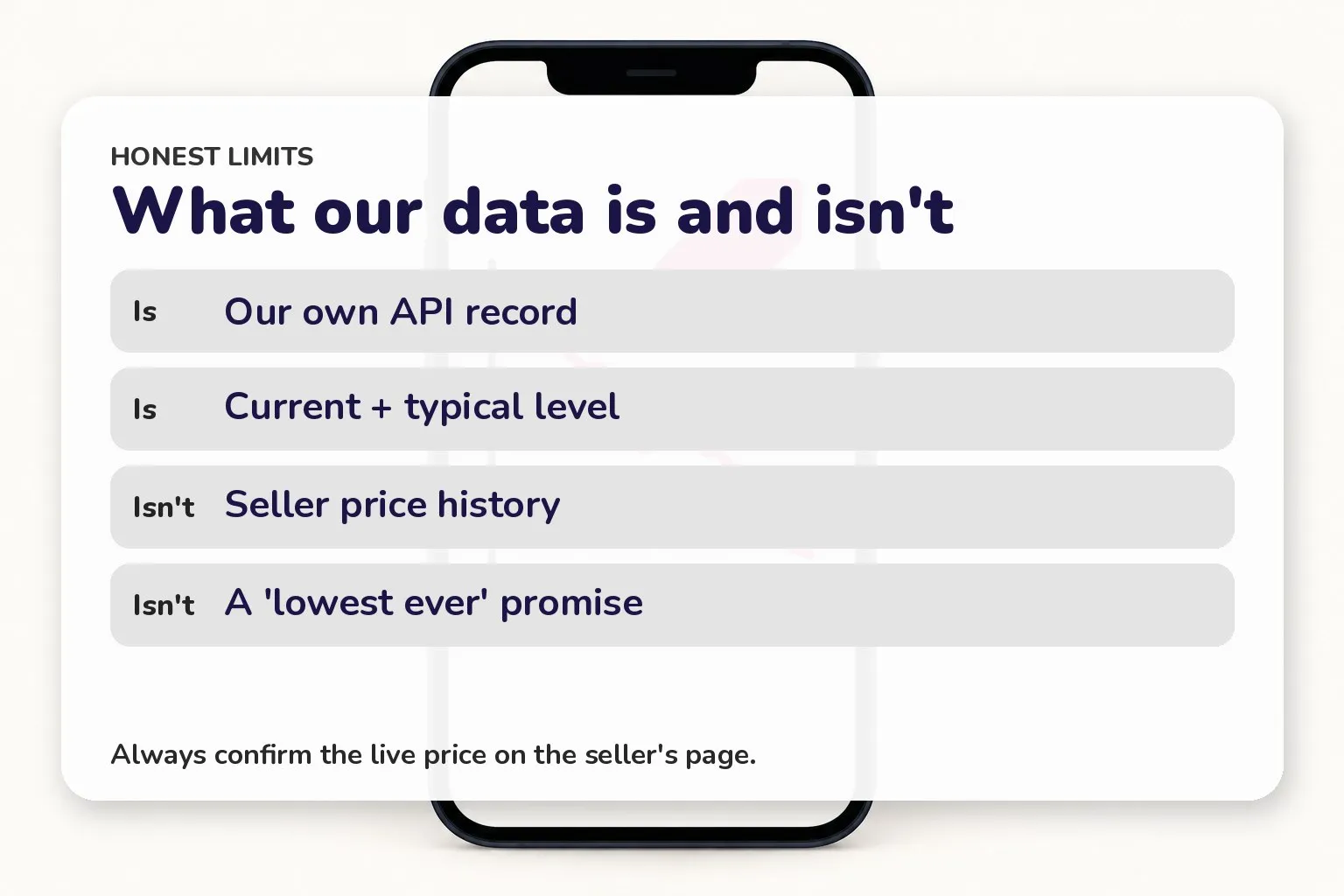
What our tracking can and cannot show. Source: our methodology; Shopee/Involve Asia APIs.
- Show the current price we last recorded from the official API.
- Show a typical level for items we have tracked over time (with at least two recorded points).
- Flag when the current price is clearly below the typical level we have seen.
We cannot:
- Show a seller’s price before we started tracking.
- Guarantee a “lowest ever” or “lowest price” — we do not make claims we cannot back with our own data.
- Promise the price you see now is still live — it may have changed since our last query.
This caution is deliberate. Singapore’s CCCS price-transparency guidelines stress that any price comparison should rest on a genuine basis; we would rather say less and be right than imply savings we cannot prove.
How to use it
Treat our tracking as a sanity check, not a verdict:
- Look at whether the current price is below the typical level we recorded.
- Open the seller’s page from our link and confirm the live price — it is the only price that counts at checkout.
- Add shipping and any vouchers to compare the true out-the-door cost.
For the manual version of this check, see how to spot fake discounts; to turn a claimed markdown into a real percentage, try our discount checker. And for how we fund the site without letting it bend our tracking, see how we make money and keep prices honest.
The bottom line
Our price tracking is a transparent, API-based record of what we have seen over time — useful for spotting when something is genuinely below its usual level, honest about its limits, and always pointing you back to the seller for the live price.
Sources
- Shopee Affiliate: API Access — Shopee (as of October 2026)
- Involve Asia (affiliate network) — Involve Asia (as of October 2026)
- CCCS Publishes Guidelines on Price Transparency — Competition and Consumer Commission of Singapore (as of September 2020)