Best Time to Buy Electronics in Singapore

There is no single best date. Line up big-ticket electronics with the double-digit sales (9.9, 11.11, 12.12) or Black Friday, and buy only when the price is clearly below what the item usually sells for.
“When is the cheapest time to buy a laptop or a phone in Singapore?” is one of the most common shopping questions — and the honest answer is that there is no single magic date. The best time is where two things line up: a major sale window, and a product that is already at a natural low point in its own release cycle. This guide shows how to read both, and how to confirm a price is genuinely good rather than just advertised as such. As always, we don’t quote live prices; we show you how to judge one.
Two clocks, not one
Electronics pricing runs on two clocks at once, and the best buys sit where they overlap.
- The sale calendar. Singapore’s online prices move most around the recurring mega-sales — the double-digit dates 9.9, 10.10, 11.11 and 12.12, plus Black Friday / Cyber Monday in late November and the mid-year Great Singapore Sale. Of these, 11.11 is generally the biggest for electronics, with 12.12 a year-end restock.
- The product cycle. Every phone, laptop, TV or console has a life of its own. Prices on a given model tend to be highest at launch and lowest once a newer version is announced or released, when retailers clear the outgoing stock.
A mediocre sale on a brand-new flagship can easily cost more than a quiet weekday price on last year’s model. Lining up a sale date with a product that is already late in its cycle is where the real savings are.
Match the category to the window
Different categories peak at different times, so it pays to know roughly where yours tends to land rather than buying on the first banner you see.
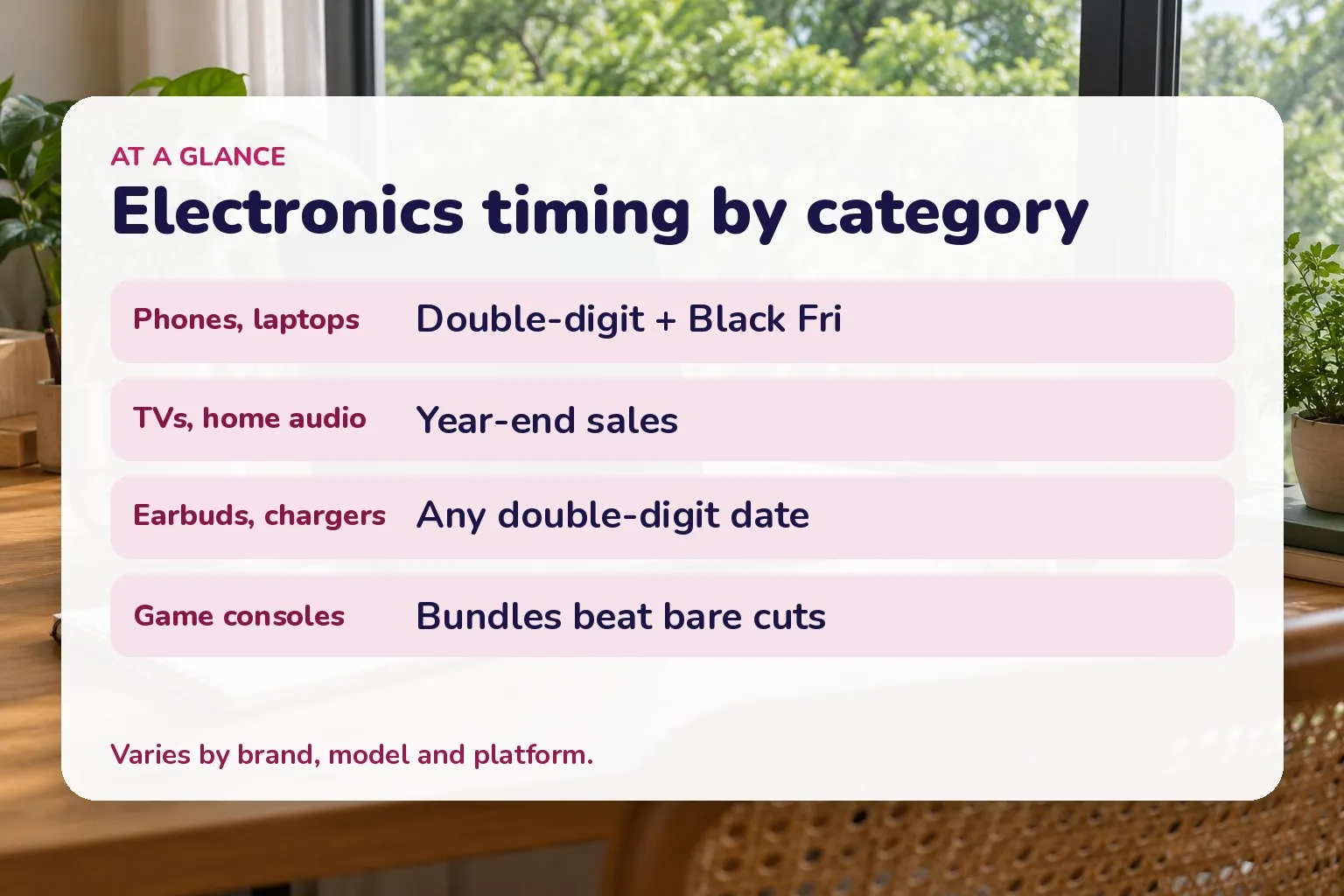
A rough guide to timing by category. Actual timing varies by brand, model and platform.
- Phones and laptops — big double-digit sales and Black Friday, and especially just after a new model is announced.
- TVs and home audio — year-end sales, when new-season ranges push last year’s panels down.
- Small gadgets and accessories (earbuds, chargers, smartwatches) — promoted so often that waiting for the next double-digit date costs little.
- Gaming consoles — tend to hold price; bundles with games or accessories at sale events are often the better value than a bare console discount.
This is a tendency, not a rule. Treat it as a reason to wait for the right window on a flexible purchase, not a guarantee that a particular week will be cheapest.
How the discount really adds up
On every mega-sale, the headline percentage is only part of the price. The real total depends on what you stack on top:
- Platform vouchers claimed before checkout, usually with a minimum spend and a cap.
- Free-shipping vouchers, which matter more on heavier items like monitors and TVs.
- Bank-card or wallet promotions tied to specific sale days.
- Coins and cashback, small but worth collecting.
Claim these before you add to cart, because two identical carts can total very differently depending on what was applied. Stacking rules, caps and minimum spends vary by platform, year and category, so check them on the day.
Check the price is actually low
A strike-through price only means something if the “usual price” behind it is genuine. Singapore’s Competition and Consumer Commission (CCCS) price-transparency guidelines say a “before” price used in a comparison should be a bona fide previous price, not one that was never really charged or was charged only briefly just before the sale.
- Know the usual price. Note what the exact model and configuration normally sells for a week or two earlier.
- Compare the same item on Shopee and Lazada — and official brand stores — with vouchers and shipping counted.
- Use our price tracking to see whether the current price is below the typical level we have recorded.
- Be wary of “before” prices that jumped just ahead of a sale.
For the detailed method, see how to spot fake discounts.
Don’t forget GST and warranty
Two things quietly change the real cost of an electronics “deal”, especially a cross-border one.
The bottom line
There is no universal best date — only the best date for your item. Decide what you want, learn its usual price, and wait for a sale window that lines up with a point in the product’s cycle when it is already falling. Claim your vouchers, add GST on cross-border buys, and confirm the “before” price is genuine before you commit. If the timing is not right, another window — 11.11, 12.12 or Black Friday — is rarely far away. For category-specific buying advice, see our guides to robot vacuums and wireless earbuds.
Affiliate disclosure: Some links on this page are affiliate links. If you apply or buy through them we may earn a commission at no extra cost to you. This never changes the rates, figures or comparisons shown — those come from official or vendor sources with an "as of" date. We do not recommend specific products.
Sources
- Best 10.10 sale offers to shop now: Amazon, Lazada, Shopee and more — The Straits Times (as of October 2026)
- CCCS Publishes Guidelines on Price Transparency — Competition and Consumer Commission of Singapore (as of September 2020)
- GST on Imported Low-Value Goods — Inland Revenue Authority of Singapore (as of October 2026)
- CPFTA & Lemon Law — Consumers Association of Singapore (CASE) (as of October 2026)