How to Avoid Online Shopping Scams in Singapore
Keep every transaction on the platform and pay only through its secure option. E-commerce scams were still Singapore's most-reported scam in 2025 with 6,703 cases; most begin when a buyer is lured off-platform to pay by bank transfer or a phishing link.
On this page10 sections · tap to jump
- 01How big the problem is
- 02How an e-commerce scam works
- 03Red flags before you pay
- 04The fake-buyer scam that targets sellers
- 05ADD, CHECK, TELL: the official playbook
- 06Pick a safer platform: the Transaction Safety Ratings
- 07If you have already been scammed
- 08Your rights if the goods are faulty, not fake
- 09Common questions
- 10The bottom line
A good deal and a scam can look identical on screen — the difference is usually one request: pay me directly, outside the app. Online shopping scams remain Singapore’s most common scam by volume, and nearly all of them follow the same script. Here is what the latest official figures show, the red flags that give a scam away, and the government’s own playbook for shopping safely — plus exactly what to do if money has already left your account.
How big the problem is
Scam numbers fell in 2025, but e-commerce scams stayed on top. According to the Singapore Police Force’s Annual Scams and Cybercrime Brief 2025, total scam cases dropped 27.6% to 37,308, and losses fell 17.9% to about S$913.1 million. Even so, e-commerce scams recorded the highest number of reported cases of any scam type — 6,703 cases, down 42.5% from 11,665 in 2024 — with about S$16.7 million lost and an average loss of S$2,503 per case.
What people get caught buying has shifted. In 2025 Pokémon trading cards were the item most commonly involved in e-commerce scams, at 13.6% of cases (concert tickets led in 2024). And the venue matters: Carousell (29.0%) and Facebook Marketplace (22.2%) were the platforms most used by scammers for e-commerce scams. Across all scam types, online platforms were the contact method in 84.1% of cases — the deal often starts on a legitimate listing before moving somewhere you can’t be protected.
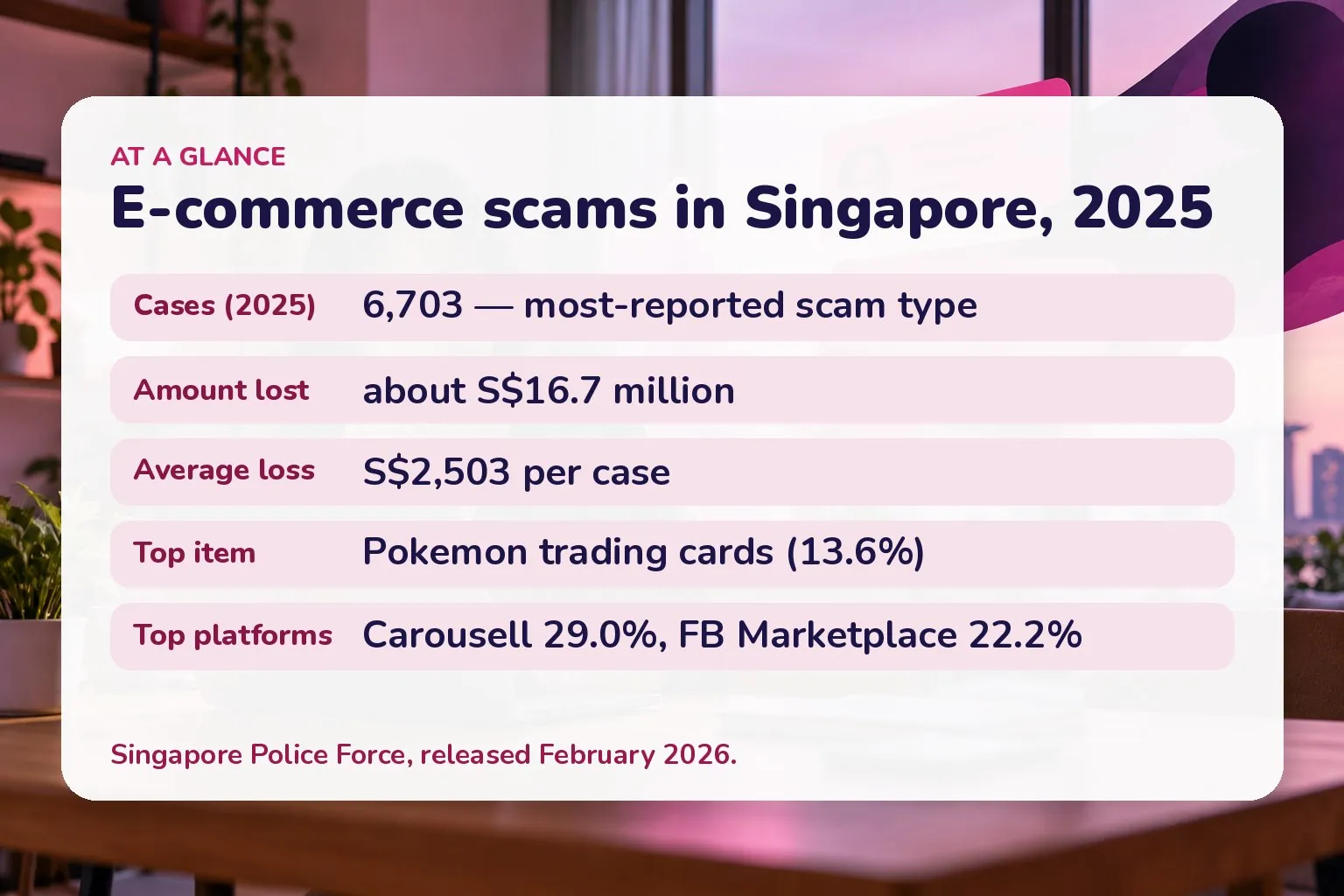
Source: Singapore Police Force, Annual Scams and Cybercrime Brief 2025 (released February 2026).
How an e-commerce scam works
ScamShield, the government’s anti-scam service, describes the pattern plainly: e-commerce scams involve the sale of goods or services without a physical meet-up. As a buyer, you find an attractive listing, pay — and the goods never arrive, or the “seller” vanishes. The scam almost always pivots the same way: the seller moves the chat to WhatsApp or Telegram and asks for payment by PayNow or bank transfer, away from the platform’s protected checkout. Once the money is sent by direct transfer, there is no escrow to claw it back.
The attractive price is the bait, and urgency is the hook — “last one”, “only today”, “pay a deposit to reserve”. The faster you are pushed to transfer, the more suspicious you should be.
Red flags before you pay
ScamShield lists the tell-tale seller behaviours. Treat any one of these as a reason to stop:
- Offers the item at an attractive price for a limited time, pressuring a quick decision.
- Asks you to pay directly — bank transfer or PayNow — and not through the platform’s secure payment option.
- Needs you to click a link or install a third-party app sent by text to make payment or “receive a refund”.
- Asks you to pay extra customs or delivery fees after the deal is already confirmed.
The fake-buyer scam that targets sellers
Scams run both ways. If you are the one selling — clearing out old gadgets or reselling tickets — you are a target too. In a police advisory issued in June 2024, the SPF warned of a phishing variant in which scammers pose as interested buyers on Carousell, Facebook Marketplace and similar platforms. After agreeing a price, the fake buyer claims to have paid and sends a phishing link or QR code — supposedly to “release” your payment or “schedule delivery”. The link leads to a spoofed bank or delivery-company page that harvests your banking login, card details and one-time passwords (OTPs). Since April 2024, at least 594 victims lost at least S$1.3 million to this one variant.
The defence is the same as for buyers: a real payment arrives in your bank app on its own. You never need to click a seller’s link, scan their QR code, or key an OTP to receive money.
ADD, CHECK, TELL: the official playbook
Singapore’s anti-scam advice follows a simple three-part structure. Build these habits before your next purchase.
ADD — the safeguards:
- Add the ScamShield app and enable two-factor or multi-factor authentication on banking apps.
- Set transaction limits and low alert thresholds on PayNow and payment accounts, so an unexpected debit is caught fast.
- Consider Money Lock with your bank to ring-fence part of your savings from transfers.
CHECK — before you commit:
- Pay only through the platform’s secure option; never by a direct transfer a seller requests off-app.
- Install apps only from official app stores, and don’t click links or scan QR codes sent by a seller over text.
- Check a platform’s Transaction Safety Rating (below), read seller reviews, and look for a verified seller identity.
- Never share personal details, banking logins or OTPs with anyone. If unsure, call the ScamShield Helpline on 1799, available 24/7.
TELL — if something is off:
- Warn family and friends, and flag the suspicious seller to the platform.
- If you think you have been scammed, call your bank immediately and make a police report.
Pick a safer platform: the Transaction Safety Ratings
Not every marketplace protects you equally, and the government publishes a scorecard. The Ministry of Home Affairs E-commerce Marketplace Transaction Safety Ratings (TSR) grade platforms on five safety features: seller-identity verification, monitoring for fraudulent behaviour, secure (escrow) payment, record-keeping, and dispute resolution.
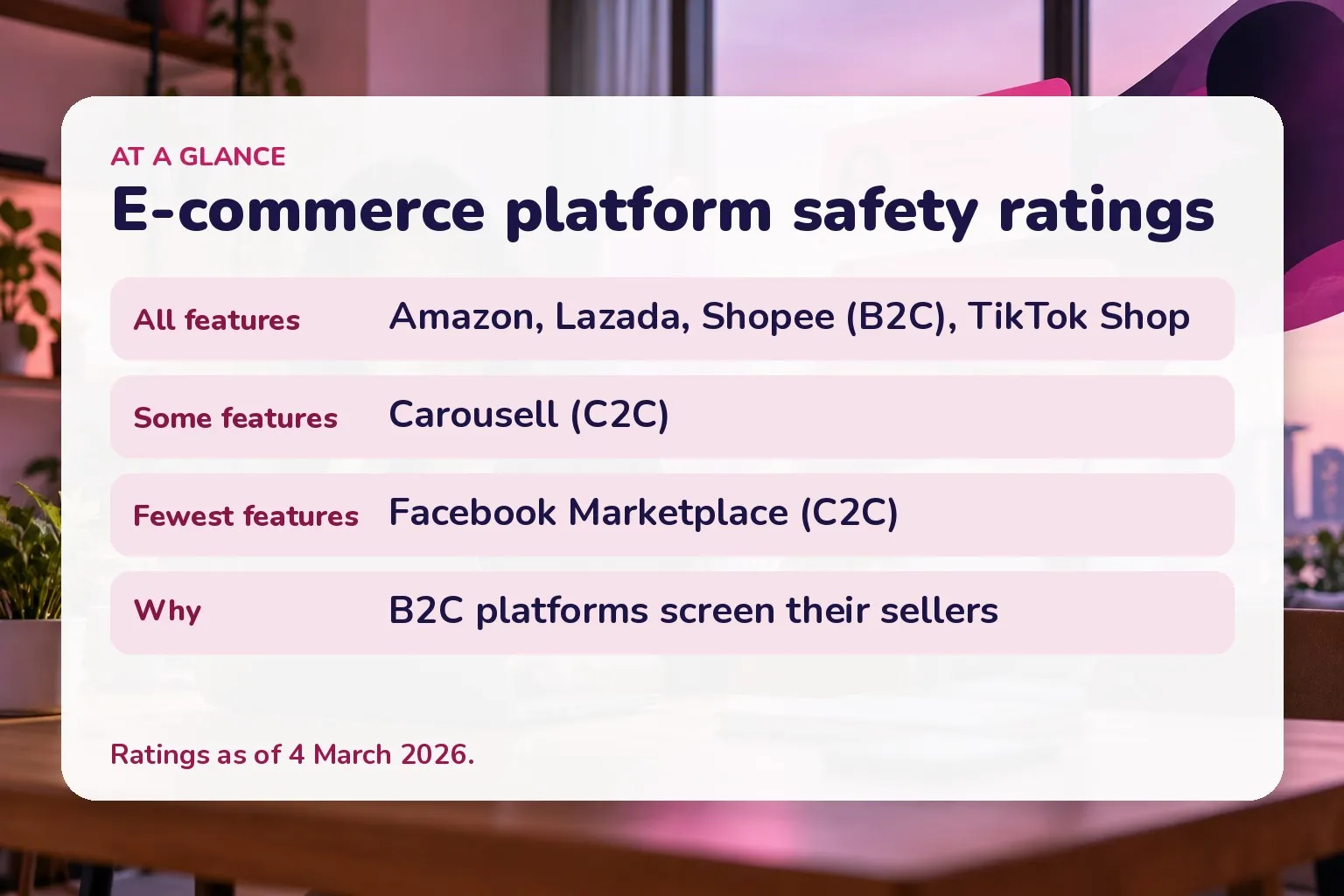
Source: Ministry of Home Affairs, E-commerce Marketplace Transaction Safety Ratings, March 2026.
- Top rating (all features in place): Amazon B2C, Lazada B2C, Shopee (B2C and C2C) and TikTok Shop.
- Some features: Carousell (C2C).
- Fewest features: Facebook Marketplace (C2C).
The pattern is not an accident: business-to-consumer (B2C) platforms screen their sellers, while on consumer-to-consumer (C2C) platforms the person on the other end may be anyone. That is also why Carousell and Facebook Marketplace feature so heavily in the scam statistics. For the same item, a verified B2C listing with in-platform payment is the safer buy — and if you do use a C2C platform, the TSR consumer advisory says to transact only with identity-verified sellers and to use the platform’s escrow payment, never an off-platform transfer.
If you have already been scammed
Speed decides how much you can recover. If you have transferred money or clicked a suspicious link:
- Call your bank immediately to freeze the account or transfer, or use your bank’s emergency “kill switch” to suspend it.
- Make a police report and call the Anti-Scam Helpline on 1800-722-6688 (or ScamShield’s 1799 to check first).
- Report the seller to the platform and submit the details — with screenshots — to the ScamShield app, which forwards them to the authorities.
- Change passwords and revoke any access if you entered banking credentials or OTPs on a suspicious page.
Keep every record: the listing, the chat, the transfer, the dates. It is what makes a report actionable.
Your rights if the goods are faulty, not fake
It helps to know the limit of consumer law here. The Consumer Protection (Fair Trading) Act (CPFTA), administered by CCCS with CASE as the first point of contact, protects you against faulty goods and unfair practices from a business seller — the Lemon Law can give you a repair, replacement or refund for goods that don’t conform to contract. But it covers purchases from a business in Singapore, not consumer-to-consumer sales, and it is a remedy for defective products, not for outright fraud where a scammer takes your money and disappears. For that, the realistic route is your bank and the police, not a consumer claim. Knowing a genuine price also helps you avoid pressure-selling — see how to spot fake discounts.
Common questions
What is the biggest red flag in an online deal? A seller who wants payment outside the platform — PayNow, bank transfer, or a link. Keep the whole transaction, including payment, inside the app.
Which platforms are safest? Those with the top MHA Transaction Safety Rating — Amazon, Lazada and Shopee (B2C) and TikTok Shop — screen sellers and hold payment. C2C platforms like Carousell and Facebook Marketplace carry more risk.
I am the seller — how can I be scammed? Fake buyers send a link or QR code claiming it “releases” your payment, then steal your banking login and OTP. Real payouts never need you to click a buyer’s link or key an OTP.
Who do I call to check or report? Call the ScamShield Helpline 1799 to check something, or the Anti-Scam Helpline 1800-722-6688 and make a police report if you have lost money.
The bottom line
Most online shopping scams are beaten by one rule: keep the whole deal — chat and payment — on a platform with a secure checkout, and never transfer money or key an OTP because a stranger’s link or QR code asked you to. Check the platform’s safety rating, pause on any “too good, pay now” offer, and if money is already gone, call your bank and the police before anything else. When you are confident the seller is real, then it is worth comparing the actual price — see Shopee vs Amazon.sg.
Sources
- Annual Scams and Cybercrime Brief 2025 — Singapore Police Force (as of February 2026)
- E-Commerce Scams — ScamShield (Singapore Government) (as of October 2026)
- Transact securely on e-commerce platforms — ScamShield (Singapore Government) (as of October 2026)
- Police Advisory on Phishing Scams Involving Fake Buyers — Singapore Police Force (as of June 2024)
- E-commerce Marketplace Transaction Safety Ratings — Ministry of Home Affairs (as of October 2026)
- ScamShield / ScamAlert — ScamShield (Singapore Government) (as of October 2026)
- Consumer Protection (Fair Trading) Act — Competition and Consumer Commission of Singapore (as of October 2026)