Best Refrigerator Deals in Singapore: How to Choose
For most Singapore homes the best-value refrigerator is a 3-tick, roughly 350–405L two-door model around S$1,000–1,200 with a low labelled running cost. Every new fridge is now at least 3-tick, so all qualify for Climate Vouchers.
On this page14 sections · tap to jump
- 01Quick verdict
- 02How the picks compare
- 03What it costs to run
- 04What the energy ticks mean
- 05Use your Climate Vouchers
- 06What size do you actually need
- 07Which door layout?
- 08When to buy
- 09Is the discount real?
- 10Buying an imported set
- 11If it arrives faulty
- 12Who should skip the winner
- 13Frequently asked questions
- 14The bottom line
Refrigerators are a mega-sale favourite in Singapore, and the strike-through prices make it easy to overpay — or to miss that one fridge costs over S$100 a year more to run than a similar one beside it. A fridge runs 24 hours a day for a decade, so the running cost matters as much as the sticker. This guide names the best buys by household size, compares models on published price, capacity and the energy label’s annual cost, and shows how to judge the discount. Prices are approximate, as of 1 November 2026, read from the retailer’s own Singapore page; they move weekly, so confirm the cash price at checkout.
Quick verdict
The ~400L two-door wins for most homes because it covers a small family’s storage, sits at a credibly discounted price, and — critically for a fridge — carries one of the lowest labelled running costs in its size class. The Sharp 360L is the close runner-up, a touch smaller but even cheaper to run. Step up to a side-by-side or multi-door only when you genuinely need the space, because they cost the most to buy and to run.
How the picks compare
The value band for a family fridge sits between about S$780 and S$1,300; side-by-side and multi-door models run higher. Representative current prices, with the NEA label’s annual energy cost:
| Fridge | Type | Capacity | Annual cost (label) | Approx. price | Usual |
|---|---|---|---|---|---|
| Toshiba GR-RT303WE | 2-door top freezer | 233L | — | ~S$699 | S$799 |
| Midea MDRT489MTB46-SG | 2-door | 339L | ~S$427 | ~S$769 | — |
| Europace ER5371W | 2-door | 333L | — | ~S$778 | S$1,099 |
| Sharp SJ-FB32E-DS | 2-door | 315L | ~S$285 | ~S$1,156 | — |
| Sharp SJ-RF36E-DS | 2-door | 360L | ~S$292 | ~S$1,006 | S$1,070 |
| LG GB-B3443PY | 2-door bottom freezer | 344L | ~S$325 | ~S$1,159 | S$1,609 |
| Panasonic NR-BX471WGWS | 2-door | 405L | ~S$303 | ~S$1,199 | S$1,429 |
| Electrolux ESE5101B-A | Side-by-side | 507L | ~S$372 | ~S$1,299 | — |
| Samsung RS70F65Q3FSS | Side-by-side | 655L | ~S$506 | ~S$1,799 | S$2,199 |
| Toshiba GR-RF900WI2 | Multi-door | 688L | ~S$493 | ~S$2,329 | — |
Ranking here is on published price, capacity and the label’s annual energy cost only — not on lab tests. The pattern: Europace, Midea and Toshiba compete on price at the entry end; Sharp, LG and Panasonic offer the best mainstream value and the lowest running costs; Samsung, Hitachi and Toshiba lead the big side-by-side and multi-door tier where both price and running cost climb.
What it costs to run
A fridge is the one appliance that never switches off, so the annual energy cost printed on its NEA label is as important as the price. The gap is real: among the two-door models above, the Sharp 315L is labelled at about S$285 a year while the Midea 339L is about S$427 — roughly S$140 a year, or over S$1,400 across a ten-year life, for similar-sized boxes.
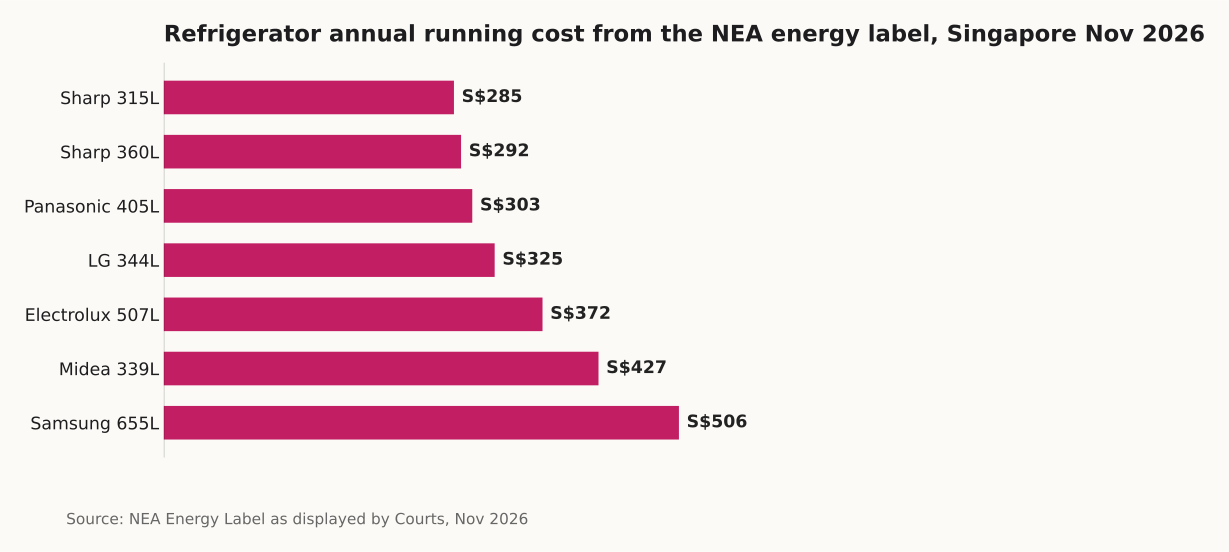
Annual running cost from each model’s NEA Energy Label, as displayed by Courts, early Nov 2026. Illustrative; the label notes actual cost may vary.
What the energy ticks mean
Every household refrigerator sold in Singapore must carry an NEA energy label, rated from 1 to 4 ticks — more ticks mean more efficient — showing the model’s estimated annual energy consumption and cost. Two rules matter. First, the minimum standard (MEPS) for all refrigerators was raised to 3-tick on 1 April 2025, so every new fridge on sale is now at least 3-tick. Second, retailers must display the label next to the product, even online, so you can compare the annual cost before buying. The label carries the disclaimer that actual consumption and cost may vary with how you use it.
Use your Climate Vouchers
Here is the discount most shoppers miss. Under the Enhanced Climate Friendly Households Programme (a joint NEA–PUB scheme launched in November 2020), every HDB household can claim S$300 plus an extra S$100 in Climate Vouchers — S$400 in total — and Singapore Citizen households in private homes qualify too. They are claimed through RedeemSG with Singpass, one set per registered address, and are valid until 31 December 2027.
Refrigerators must be 3-tick or above to qualify — and since every new fridge is now at least 3-tick, effectively all of them are eligible. Spend the vouchers at a participating retailer and a S$1,199 fridge can cost you several hundred dollars less, on top of any sale price.
What size do you actually need
Capacity (in litres) is the decision that matters most:
- 150–250L — enough for one or two people or a small flat; a compact two-door (e.g. the Toshiba 233L).
- 300–400L — the small-family all-rounder, where the best value and lowest running costs sit.
- 450–550L — for larger families who cook and store a lot.
- 600L+ — side-by-side and multi-door fridges for big households; the priciest to buy and run.
Size for your kitchen and your weekly shop, not the showroom. An oversized fridge wastes energy cooling empty space every day.
Which door layout?
A two-door (top- or bottom-freezer) fridge is the value choice for most homes: the cheapest to buy, the lowest running costs, and plenty for a small family. A side-by-side gives tall, narrow fresh and freezer columns and often water/ice dispensers, but costs more and runs dearer — the Samsung 655L is labelled around S$506 a year versus about S$303 for the Panasonic 405L. A multi-door / French-door model offers the most flexible compartments and the widest shelves for a big family, at the highest price. Match the layout to your space and budget, not the look.
When to buy
Fridges are promoted hard around the double-digit sales — 9.9, 10.10, 11.11 and 12.12 — plus year-end and mid-year electronics fairs. These windows recur every few weeks, so patience pays. For a higher-value fridge it is worth tracking the exact model for a week or two first.
Is the discount real?
A fridge marked down from S$1,609 to S$1,159 looks dramatic, but strike-throughs are routine, so judge the cash price, not the badge. The CCCS Guidelines on Price Transparency, in force since 1 November 2020, say a discount or “usual price” comparison must be a genuine price benefit with a valid basis, that sellers should not inflate prices before discounting, and that a time-limited offer must state its period clearly.
- Note the usual price across two or three sellers before the campaign.
- Compare the exact model and capacity on Shopee and Lazada, with vouchers and shipping added — see Shopee vs Lazada.
- Use our price tracking to see whether the current price is below the typical recorded level.
- Treat the “before” price with suspicion. CCCS guidance expects sellers to keep records proving a reference price is genuine, so verify the baseline yourself — see how to spot fake discounts.
Buying an imported set
A fridge costs well over S$400, so Singapore’s low-value-goods rule (GST charged at checkout only for imports of S$400 or less from a GST-registered seller) rarely helps you. An imported fridge above S$400 instead has 9% GST collected at the border on its full value, on top of shipping — and servicing a grey import, or getting a bulky unit replaced, can be hard. A local set with a Singapore warranty is usually the safer buy.
If it arrives faulty
Who should skip the winner
The ~400L two-door is the wrong buy if you live alone — a 233L compact is cheaper to buy and run — or if you have a large family who cook daily, where a 500L+ side-by-side or multi-door earns its space. It is also wrong if you specifically want a water and ice dispenser or French-door shelving, which start higher up the range. Measure your kitchen opening and the door swing before committing to any large model.
Frequently asked questions
Is an inverter compressor worth it? Generally yes: inverter compressors run more efficiently and show up as a lower labelled annual cost, which pays back over a fridge’s long life. Compare the label figure rather than the marketing term.
Do I need plumbing for a water dispenser? Some side-by-side and multi-door models need a water line; others are non-plumbing with an internal tank. Check the spec before buying if you want chilled water.
Should I wait for a sale? If the cash price for the exact model is clearly below the usual price and the typical tracked level, buy. Otherwise wait — campaigns recur through the year.
The bottom line
Buy the capacity your household actually uses, compare the NEA label’s annual cost as hard as the price, claim your Climate Vouchers while they last, and pay only when the cash price is clearly below the usual level. For the full price-check method see how to spot fake discounts, and for the other big sale-season appliance see best washing machine deals.
Affiliate disclosure: Some links on this page are affiliate links. If you apply or buy through them we may earn a commission at no extra cost to you. This never changes the rates, figures or comparisons shown — those come from official or vendor sources with an "as of" date. We do not recommend specific products.
Sources
- About Mandatory Energy Labelling (MELS) and Minimum Energy Performance Standards (MEPS) — National Environment Agency (as of November 2026)
- The Energy Label — National Environment Agency (as of November 2026)
- Enhanced Climate Friendly Households Programme (Climate Vouchers) — NEA & PUB (as of November 2026)
- Climate Vouchers — eligible products (FAQ) — NEA & PUB (as of November 2026)
- 2 Door Fridges (prices, annual energy cost) — Courts Singapore (as of November 2026)
- Side By Side Fridges (prices, annual energy cost) — Courts Singapore (as of November 2026)
- CCCS Guidelines on Price Transparency — Competition and Consumer Commission of Singapore (as of November 2026)
- CPFTA & Lemon Law — Consumers Association of Singapore (CASE) (as of November 2026)
- GST on Imported Low-Value Goods — Inland Revenue Authority of Singapore (as of November 2026)
- GST Rate Change (9% from 1 Jan 2024) — Inland Revenue Authority of Singapore (as of November 2026)