Local vs International Warranty in Singapore: What to Know

A local warranty is honoured at service centres here through the authorised distributor; an international warranty is honoured by the brand across markets but can mean shipping the item abroad. Either way, Singapore's Lemon Law protects goods bought here whatever the warranty says.
On this page10 sections · tap to jump
- 01Local vs international warranty: the difference
- 02Where parallel imports fit
- 03Your statutory rights come first
- 04Who you actually claim from
- 05The hidden cost of an overseas claim
- 06When each one is the right call
- 07A pre-purchase checklist
- 08Extended warranties, briefly
- 09If a seller won’t help
- 10The bottom line
A sale listing often shows a lower price with the words “international warranty” or “seller warranty” in small print, while the authorised store charges more for a “local warranty”. The gap is real, and so is the saving — but they do not buy the same thing. This guide explains what each warranty actually covers, where parallel imports fit, and why your legal rights in Singapore sit on top of any warranty at all.
Local vs international warranty: the difference
A warranty is a voluntary promise from the manufacturer or seller to repair or replace a product that fails within a set period. It is a contract, so what matters is its wording — especially where and by whom it is honoured.
- A local warranty (sometimes “set warranty”) is backed by the brand’s authorised distributor in Singapore. You claim at a local service centre, parts are held locally, and turnaround is usually faster. It is priced into the authorised product.
- An international or global warranty is honoured by the manufacturer across many markets, but the practical route can mean dealing with a regional service centre or sending the unit back to the country it was sold for. The printed period may read the same as a local warranty while the claim path is very different.
- A seller warranty is a promise from the importer or shop, not the brand. It lasts only as long as that company keeps trading and honours it.
| What to check | Local warranty | International / global warranty |
|---|---|---|
| Who honours it | Authorised Singapore distributor | Brand’s regional/overseas service centre |
| Where you claim | Local service centre | May require shipping abroad |
| Typical turnaround | Faster; local parts stock | Slower; depends on the market |
| Hidden cost | Built into the price | Return freight + possible re-import GST |
| If the seller closes | Brand relationship usually survives | Cover may be only as good as the importer |
A general comparison; always read the specific warranty card’s terms.
Where parallel imports fit
Cheaper “international warranty” listings are often parallel imports — also called grey imports. These are genuine goods that the brand put on the market in another country, bought there and brought into Singapore through a channel the manufacturer never appointed. They are legal: under the exhaustion-of-rights principle in section 29(1) of the Trade Marks Act, a registered trade mark is not infringed by reselling goods that the proprietor already put on the market, “whether in Singapore or outside Singapore”. Singapore’s courts have repeatedly confirmed that parallel imports are genuine goods, as opposed to counterfeits.
The saving is real because the unofficial channel skips the costs the authorised one carries — local claim handling, a parts inventory, trained technicians. Strip those out and identical hardware costs less. But the thing removed to create the saving is exactly the local service you may later want.
Your statutory rights come first
Whatever the warranty says, a separate layer of protection applies to anything bought in Singapore: the Lemon Law, in Part 3 (Sections 13–18) of the Consumer Protection (Fair Trading) Act (CPFTA). It gives a consumer the right to ask for repair, replacement, a reduction in price, or rescission (a refund) when goods do not conform to the contract — for example, if they are faulty, not of satisfactory quality, or not as described.
Key points from CASE and the Ministry of Trade and Industry’s advisory:
- It covers all general consumer products purchased in Singapore — apparel, electronics, furniture, motorcars and more. It does not apply to houses or land, rental/leased goods, or services, nor to business-to-business or consumer-to-consumer sales.
- Second-hand goods are included, though “satisfactory quality” takes into account their age and the price paid.
- The retailer usually gets first choice of repair or replacement and a reasonable time to do it; if that fails or is unreasonable, you can seek a price reduction or refund.
- A six-month presumption applies: if a defect appears within six months of delivery, it is presumed to have been there at delivery unless the retailer proves otherwise. After six months, you must prove the defect existed at delivery.
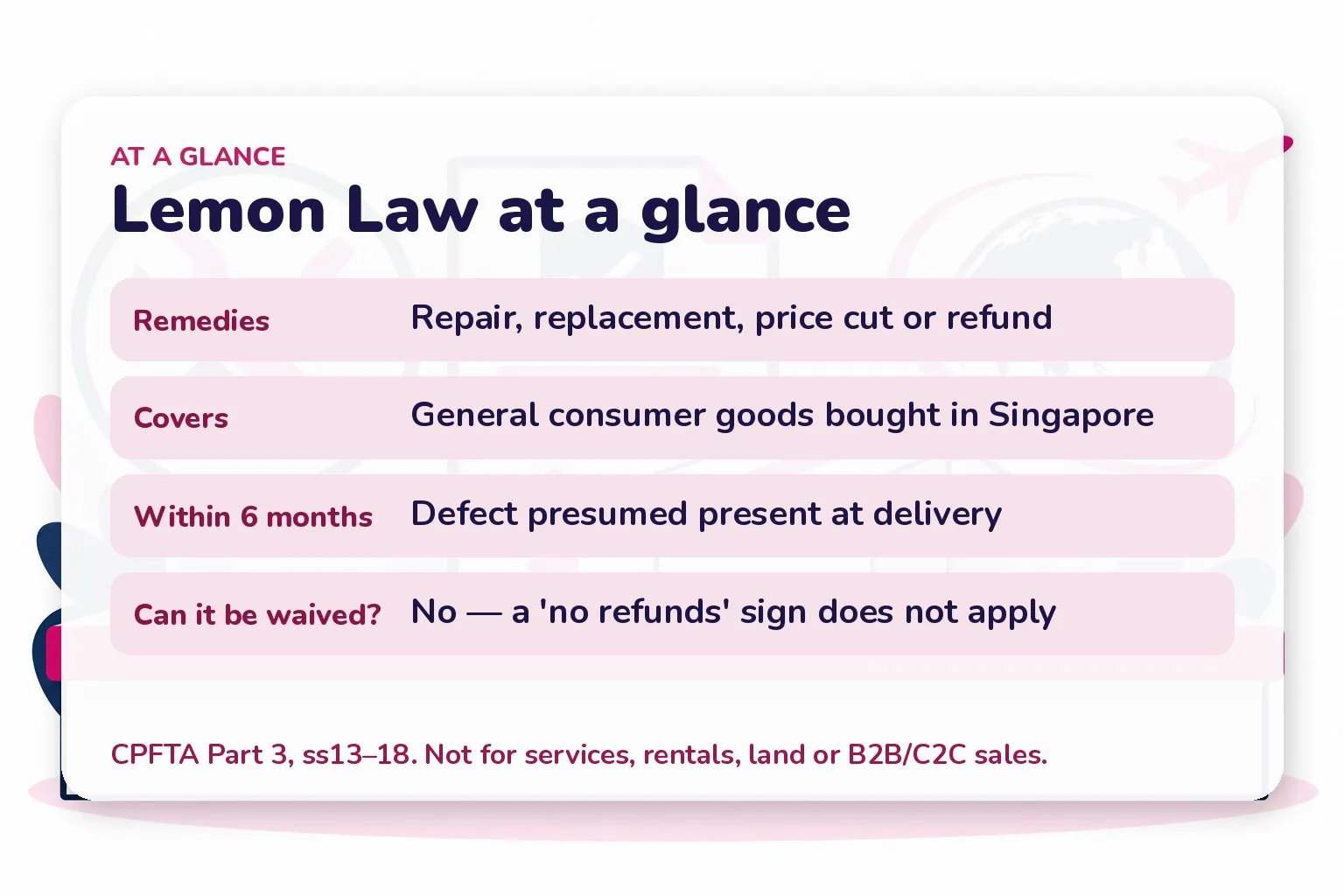
What the Lemon Law gives a buyer of faulty goods. Source: CASE / MTI, Oct 2026.
The protection is not unlimited. You have no Lemon Law remedy if you damaged or misused the item, tried to repair it yourself and caused the damage, were told about the fault before buying, simply changed your mind, or the fault is ordinary wear and tear.
Who you actually claim from
When something fails, the first question is who holds the obligation — and it is not always the brand.
- The retailer you bought from is your Lemon Law counterparty for faulty goods bought in Singapore, regardless of any warranty. Start here.
- The authorised distributor services a local warranty at its own service centres.
- The manufacturer honours an international/global warranty, but may route you through a regional centre or the market of origin.
- The importer or shop stands behind a seller warranty — worth only as much as that business’s willingness and ability to honour it.
For a parallel import, routes 1 and 4 are often your realistic options; the local distributor is under no obligation to service a unit it never brought in.
The hidden cost of an overseas claim
An international warranty can be perfectly valid and still cost you. If a repair means sending the product out of Singapore and receiving it back, the return is an import. GST has been 9% since 1 January 2024, levied on the cost-insurance-freight (CIF) value of imported goods, and for low-value goods (sales value S$400 or less) sent by air or post from a GST-registered supplier it is charged at the point of purchase; higher-value or sea/land parcels are taxed at the border with no S$400 relief. Add international freight and the time without your device, and a “free” overseas repair can quietly cost real money — sometimes more than a local repair would have.
When each one is the right call
- Choose a local warranty for anything you expect to need serviced — appliances, phones, cameras, laptops — or where downtime matters. The premium buys local parts, faster turnaround and a claim you can walk into.
- An international warranty can be fine for low-failure-risk items, cheap accessories, or when the price gap is large and you accept the overseas-claim risk with eyes open.
- Read the territory clause either way. The brand name on the box does not decide where you claim; the warranty card’s wording does.
A pre-purchase checklist
Before buying a discounted listing, especially during a sale, ask:
- Is this a local (set) warranty or an international/seller warranty? Get the answer in writing from the seller.
- Where would I claim, and who pays return shipping? A local service centre or an overseas address changes everything.
- Does the saving survive one realistic repair once freight and possible re-import GST are added?
- Is the seller established enough to honour a seller warranty for its full term?
- Keep the receipt, invoice and any chat messages — you will need them for a warranty or a Lemon Law claim. For judging whether the “discount” itself is genuine, see how to spot fake discounts.
Extended warranties, briefly
Shops often offer a paid extended warranty at checkout, frequently an insurance product branded under the retailer and sitting on top of the manufacturer’s cover. Before paying extra, check the period against the manufacturer’s warranty, the price against what a repair would actually cost, exactly what is covered and excluded, and whether the technology will be worth repairing by the time it fails. It is a cost-benefit call, not a default.
If a seller won’t help
If a retailer refuses a reasonable remedy for faulty goods, you have recourse. The Consumers Association of Singapore (CASE) is the first point of contact and can help negotiate or mediate; persistent errant suppliers are referred to the Competition and Consumer Commission of Singapore (CCCS), which administers the CPFTA. If the matter cannot be settled, the Small Claims Tribunals hear consumer disputes over goods and services — up to S$20,000, or S$30,000 if both parties agree. Bring your receipts, invoices and correspondence; a dated record is what makes a claim easy to act on.
The bottom line
A local warranty costs more because it buys local service; an international or seller warranty is cheaper because that service has been stripped out, not because you are protected the same way. Decide by how likely the item is to need repair and whether the saving survives one overseas claim. And remember the floor beneath every purchase made in Singapore: the Lemon Law gives you a repair, replacement, price reduction or refund on genuinely faulty goods, no matter what the warranty — or a “no refunds” sign — says. Planning a cross-border buy in a sale? Weigh it against Black Friday versus 11.11 and Shopee versus Lazada for deals first.
Sources
- CPFTA & Lemon Law — Consumers Association of Singapore (CASE) (as of October 2026)
- General Advisory on Amendments to the CPFTA and Hire-Purchase Act (Lemon Law) — Ministry of Trade and Industry (MTI) (as of October 2026)
- Consumer Protection (Fair Trading) Act 2003 — Singapore Statutes Online (AGC) (as of October 2026)
- Trade Marks Act 1998 (section 29, exhaustion of rights) — Singapore Statutes Online (AGC) (as of October 2026)
- Consumer Protection FAQs — Competition and Consumer Commission of Singapore (as of October 2026)
- Small claims — Singapore Courts (as of October 2026)
- GST on Imported Low-Value Goods — Inland Revenue Authority of Singapore (as of October 2026)
- Import Procedures Overview — Singapore Customs (as of October 2026)