Black Friday vs 11.11 in Singapore: Which Wins?

For everyday Shopee and Lazada buys, 11.11 (11 November) is usually the better event. Black Friday (Friday 27 November 2026) wins mainly for imported tech, Amazon SG and global-brand stores. Compare the delivered, 9% GST-paid total first.
On this page10 sections · tap to jump
Black Friday and 11.11 land within a fortnight of each other, yet they are not the same kind of sale. 11.11 (Singles’ Day) is the flagship of the online marketplace calendar; Black Friday is an imported event that is strongest for overseas and global-brand shopping. So the honest question is not “which is bigger?” but “which is cheaper for the thing I actually want?” This page compares the two head to head and names a winner for each situation.
Quick verdict
For most Singapore marketplace shopping, 11.11 wins. If you would normally buy the item on Shopee or Lazada, 11.11 (11 November) is usually the deepest, widest event of the year — the largest voucher pools and the broadest brand participation. Default to 11.11 for everyday buys, local-stock electronics, home, fashion and anything you want delivered quickly without import tax.
Black Friday is the runner-up — and the winner for imported goods. Black Friday 2026 falls on Friday 27 November, with Cyber Monday on 30 November. It tends to beat 11.11 only in specific lanes:
- Imported tech and global-brand stores → Black Friday. International electronics, software subscriptions and worldwide-campaign brands run their deepest cuts here.
- Amazon SG and overseas official stores → Black Friday / Cyber Monday. Amazon does not run 11.11 as a dated marketplace event the way Shopee and Lazada do, so this is frequently its best-value window.
- Everyday Shopee / Lazada buys → 11.11. Local marketplace pricing usually matches or beats Black Friday, with no import GST to add.
- A specific high-demand item you must secure → 11.11. Selection is widest at the flagship; popular stock thins by late November.
The two events, side by side
Only the headline dates are fixed. 11.11 always falls on 11 November; Black Friday is pinned to US Thanksgiving — the fourth Thursday of November — so in 2026 Thanksgiving is Thursday 26 November and Black Friday is the Friday after, 27 November, with Cyber Monday on Monday 30 November. Everything else below is a tendency, not a rule.
| What matters | 11.11 (11 Nov 2026) | Black Friday (27 Nov 2026) |
|---|---|---|
| What it is | Flagship online marketplace sale (Singles’ Day) | Imported US event, day after Thanksgiving |
| Where the deals live | Shopee, Lazada and local marketplaces | Amazon SG, global-brand and overseas stores |
| Strongest for | Everyday buys, local-stock items, must-have stock | Imported tech, software, worldwide-campaign brands |
| Weakest for | Overseas-only brands not on the marketplaces | Items better priced locally once GST is added |
| How savings stack | Platform + free-shipping + coin vouchers at checkout | Store-level discount, sometimes a code |
| Cross-border GST | Usually none (local stock) | 9% GST + shipping on overseas orders |
| Position in the year | Sets the year’s benchmark price | Follows 11.11; precedes 12.12 |
A general comparison; actual deals vary by platform, seller and category.
Which wins, by use case
- Buying across several categories on a marketplace → 11.11. The widest participation and deepest vouchers make it the safest default for a long list.
- An imported gadget, a global software deal, a US-brand store → Black Friday. This is the one window built for exactly that kind of purchase, and Cyber Monday (30 November) is often the single biggest online day for international retailers.
- Anything on Amazon SG → Black Friday / Cyber Monday. Amazon leans on this event rather than the double-digit dates.
- A hot, limited-stock item → 11.11. Buy at the flagship while selection is widest; by late November it may be gone or only at third-party prices.
- You are not sure a “deal” is real → whichever comes with your own benchmark. Note the usual price before November and judge both events against it.
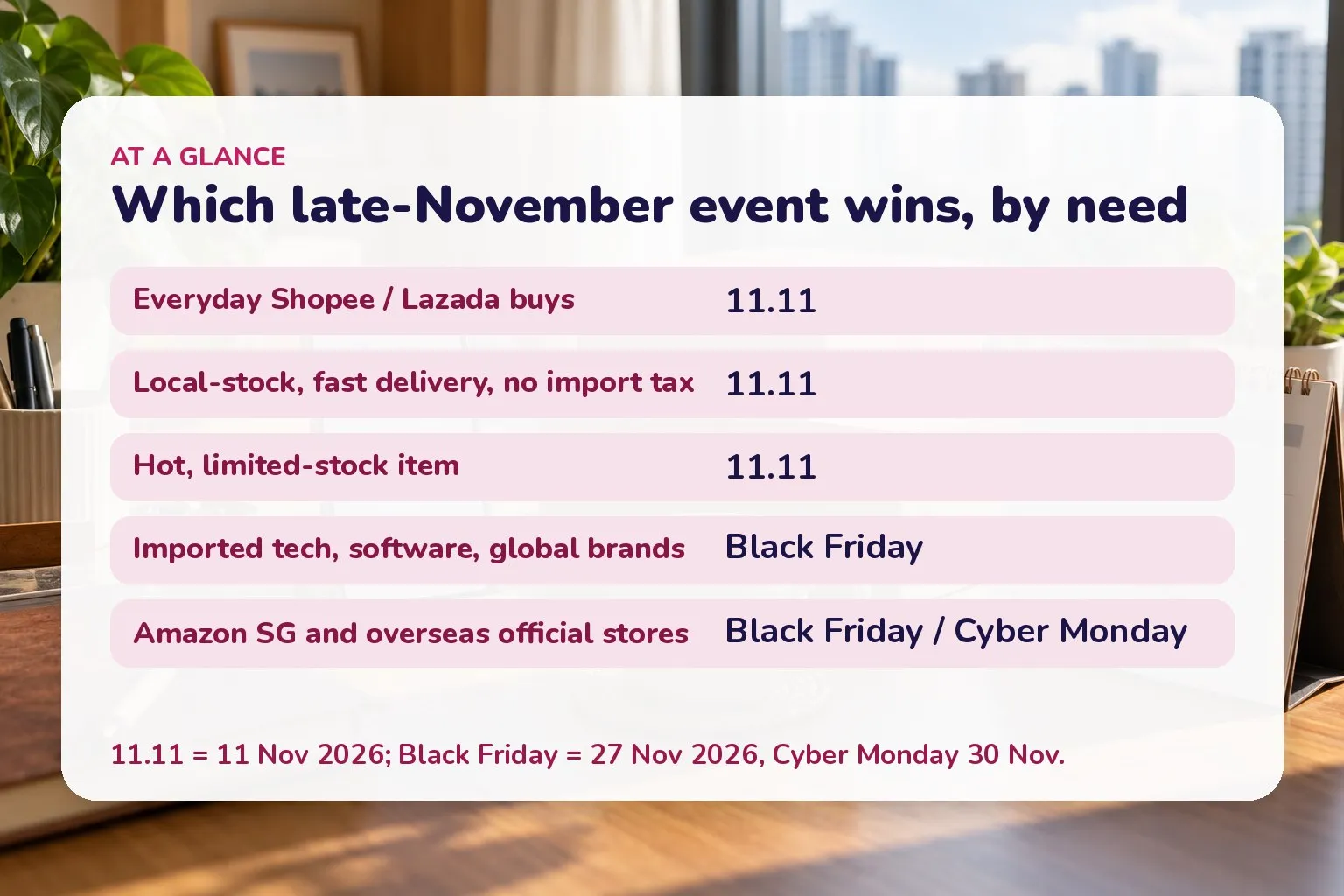
Which late-November event to pick for each kind of purchase.
How the savings actually work
The two events save money differently, and that is the real reason the winner depends on what you buy.
On 11.11, the headline percentage is only part of it. The genuine saving comes from what you claim yourself before checkout: platform vouchers (store-wide or category, usually with a minimum spend and a cap), free-shipping vouchers — often the difference between a real deal and a mediocre one — and coins or cashback, worth collecting but rarely decisive. Two identical carts can total very differently depending on what you remembered to claim, so claim your vouchers first, then shop. For how the two marketplaces themselves compare, see Shopee vs Lazada for deals.
On Black Friday, the discount is usually applied at the store, sometimes with a code — simpler, but the number you see is rarely the number you pay once an overseas order crosses the border.
Compare like for like: GST and shipping
A price is only comparable once delivery and tax are in it, and that is where Black Friday’s imported deals need care. Singapore’s GST has been 9% since 1 January 2024, and how it lands depends on how the parcel arrives:
- Air or post, sales value S$400 or less, from a GST-registered seller → 9% GST is charged at checkout and shown in a GST-inclusive price; nothing more is collected at the border. “Sales value” is the goods price and excludes separately stated shipping and insurance.
- Air or post, more than S$400 → GST is applied to the full value and collected at importation, usually by your courier or SingPost before delivery.
- Sea or land, any value → there is no S$400 import relief at all; GST is payable regardless of value, levied on the cost-insurance-freight (CIF) value.
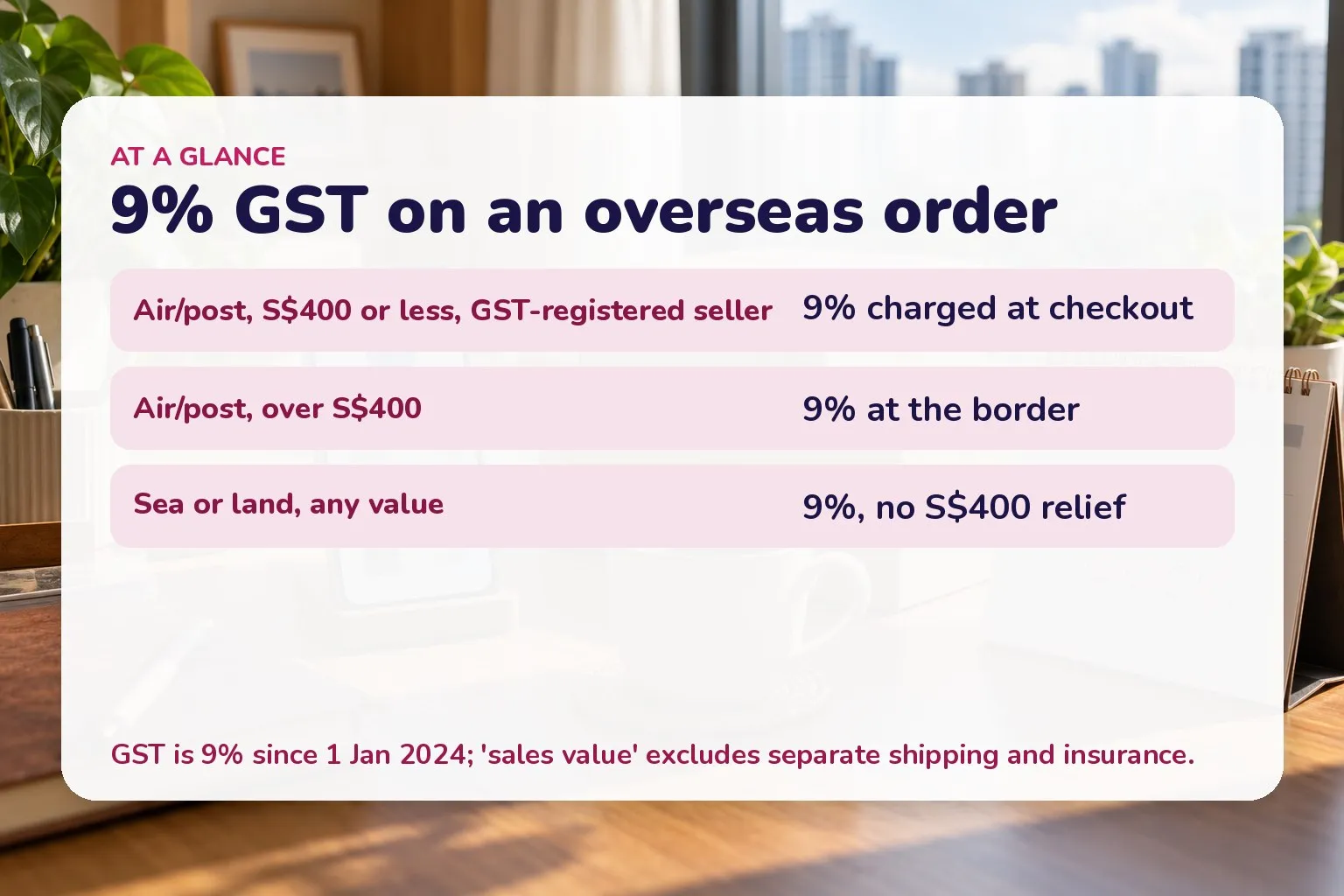
How 9% GST applies to a cross-border Black Friday order. Source: IRAS, Oct 2026.
Is the discount even real?
Whichever event you pick, a strike-through only means something if the “usual price” is genuine. Singapore’s Competition and Consumer Commission (CCCS) Guidelines on Price Transparency, in effect since 1 November 2020 and applying to all suppliers online or in store, say a discount or price comparison should be genuine and rest on a valid basis, and that time-limited offers should state their period clearly. The same Guidelines’ drip-pricing rule says unavoidable charges such as taxes and fees belong in the headline price, not sprung at the final step. And under section 18A(1) of the CPFTA, if a dispute reaches court the supplier must prove it complied — so a seller that cannot show its “before” price was ever genuinely charged is on the wrong side of the test.
A worked example (illustrative)
Say you want a pair of wireless earbuds that usually sells for about S$150.
- On 11.11, a local Shopee or Lazada listing shows them at S$129, and a stacked free-shipping voucher brings the delivered total to S$119 — no import tax, because the stock is local.
- On Black Friday, an overseas store lists the same model at US$89 (roughly S$120) with “45% off”. Add about S$15 international shipping and 9% GST on the S$120 goods value (about S$11), and the delivered, tax-paid total is around S$146.
The Black Friday banner looks bigger, but the 11.11 price wins once tax and shipping are counted. The decision comes from the delivered total against your S$150 benchmark — not the headline percentage. (Figures are illustrative; check the real prices and the seller’s GST registration on the day.)
Who should not pick the “winner”
- Do not default to 11.11 for an overseas-only brand that never lists on Shopee or Lazada — Black Friday or Cyber Monday is the event built for it.
- Do not default to Black Friday for everyday marketplace goods — once 9% GST and shipping are added, the local 11.11 price usually wins, and you keep local stock and faster delivery.
- Do not wait a fortnight for a hot item hoping the other event is cheaper; the biggest risk is a sell-out, not a missed discount.
If something goes wrong
If an item from either sale arrives faulty, your protection does not depend on which event ran the discount. For goods bought in Singapore, the Lemon Law lets you ask for a repair or replacement first, and a price reduction or refund if that fails — but not for a simple change of mind. On imported buys, where you claim and who honours the warranty matters more, so it is worth understanding local versus international warranty before you buy across the border. For the full picture on whether Black Friday is worth it at all in Singapore, see our Black Friday guide.
The bottom line
Pick 11.11 for anything you would buy on a local marketplace — it is usually the cheapest, fastest, tax-free option. Switch to Black Friday (27 November 2026) for imported tech, global-brand stores and Amazon SG, where it is genuinely the better window. Either way the method is the same: know the usual price, claim your vouchers, add shipping and 9% GST on anything crossing the border, and only buy when the delivered total is the lowest you have seen.
Affiliate disclosure: Some links on this page are affiliate links. If you apply or buy through them we may earn a commission at no extra cost to you. This never changes the rates, figures or comparisons shown — those come from official or vendor sources with an "as of" date. We do not recommend specific products.
Sources
- GST on Imported Low-Value Goods — Inland Revenue Authority of Singapore (as of October 2026)
- Import Procedures Overview — Singapore Customs (as of October 2026)
- CCCS Publishes Guidelines on Price Transparency — Competition and Consumer Commission of Singapore (as of October 2026)
- 11.11 Big Sale — Shopee Singapore (as of October 2026)
- When Is Black Friday 2026? Dates and Cyber Monday — Upcoming Days (as of October 2026)
- CPFTA & Lemon Law — Consumers Association of Singapore (CASE) (as of October 2026)