11.11 vs 12.12 Singapore: Which Sale Is Better?

For the lowest prices and the widest choice, 11.11 (Singles' Day, 11 November) is the better sale overall — it is the global flagship event. Pick 12.12 (12 December) when you missed 11.11 or need gifts to arrive before Christmas.
On this page9 sections · tap to jump
11.11 and 12.12 are Singapore’s two biggest year-end online sales, landing about a month apart on Shopee, Lazada and other marketplaces. They look almost identical — same voucher stacking, same flash deals, same banners — so which one should you actually plan around? This page compares them head to head, names a winner for each situation, and shows how to judge a deal fairly across the two.
Quick verdict
Overall winner: 11.11. As Singles’ Day, it is the flagship of the global online-sale calendar — Alibaba turned the informal Chinese holiday into a shopping event in 2009 and built it into “the world’s biggest online sales fest, dwarfing Cyber Monday”. In Singapore that generally translates into the largest voucher pools, the widest brand participation and the lowest headline prices of the year. If you can buy across categories and are flexible on timing, default to 11.11.
Runner-up: 12.12. It is a genuine second chance rather than a lesser clone — the last big marketplace date before Christmas, with a useful November benchmark behind it. Pick it in these cases:
- Christmas gifts that must arrive in time → 12.12. It is the final big sale before 25 December, so it doubles as the last practical gift-buying window.
- You missed 11.11, or weren’t ready → 12.12. A month later, you still get sale-level pricing with fresh vouchers.
- You want to verify a deal is real → 12.12. You can compare December’s price against the November one you already saw.
- Lowest price on something flexible / buying across categories → 11.11. The deepest, widest event of the year.
- A specific popular item you must secure → 11.11. Stock and selection are widest at the flagship; sell-outs are common by December.
The two dates, side by side
Only the headline date is fixed by the name: 11.11 falls on 11 November, 12.12 on 12 December, roughly a month apart. Everything else is a tendency, not a rule.
| What matters | 11.11 (Singles’ Day) | 12.12 (year-end) |
|---|---|---|
| Date | 11 November | 12 December |
| Position in the year | Flagship of the global sale calendar | Last big marketplace date before Christmas |
| Typical standing | Usually the largest: deepest vouchers, widest participation | Strong second chance; still mega-tier |
| November benchmark | None — it sets the benchmark | Yes — judge against the 11.11 price you saw |
| Christmas-gift timing | Early; gifts may sit for weeks | Late; doubles as the gift-delivery deadline |
| Stock and selection | Widest of the year | Thinner on items that sold out in November |
| How savings stack | Platform + free-shipping + coin vouchers, claimed first | Identical mechanics |
| Best for | Lowest price, widest choice, must-have items | Missed items, gifts, verifying a deal is genuine |
A general comparison; actual deals vary by platform, seller and category.
How both sales actually save you money
The important thing to understand is that 11.11 and 12.12 use the same discount machinery, so switching between them changes your timing, not your method. On both, the headline percentage is only part of the price. The real saving comes from what you claim or apply yourself:
- Platform vouchers — store-wide or category vouchers claimed before checkout, usually with a minimum spend and a cap.
- Free-shipping vouchers — often the difference between a real deal and a mediocre one once delivery is counted.
- Coins and cashback — small balances worth collecting but rarely decisive on their own.
- Flash sales and official-store drops — where the best genuine prices tend to sit if the item was already keenly priced.
Because these combine, two identical carts can total very differently depending on what you remembered to claim. Claim your vouchers first on either date, then shop. Stacking rules, caps and minimum spends vary by platform, year and category, so check them on the day. For how the two marketplaces themselves differ, see Shopee vs Lazada: where are deals better.
Which wins, by use case
- Buying across several categories and flexible on timing → 11.11. The widest participation and deepest vouchers make it the safest default when you have a long list.
- A specific high-demand item (a popular gadget, a hot toy) → 11.11. Selection is widest at the flagship; the same item is often out of stock or down to third-party sellers by December.
- Christmas gifts → 12.12. It is the last big sale that still leaves time for delivery before the 25th, and gifting categories get heavy promotion.
- You missed November entirely → 12.12. You lose a little depth but still shop at sale prices with fresh vouchers.
- You are unsure a “deal” is genuine → 12.12. The month-old 11.11 price is the best benchmark you will ever have for the same item.
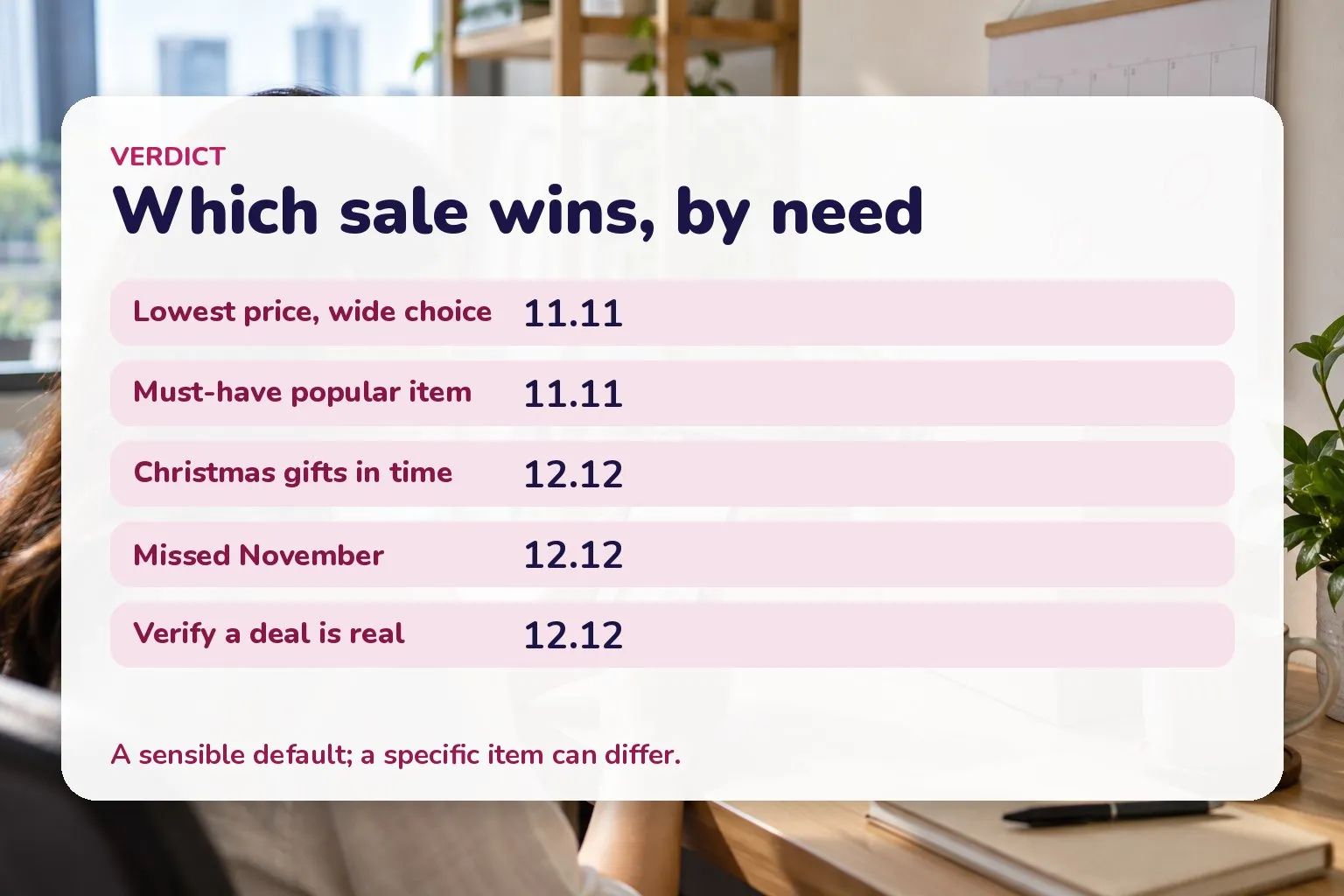
Which year-end sale to pick for each situation.
The one real edge 12.12 has
For all that 11.11 is bigger, December holds one advantage the November event cannot: recent data. By 12.12 you have already seen the 11.11 price — and, for many shoppers, the Black Friday price too. That turns a vague “is this cheap?” into a concrete comparison.
Who should NOT wait for the other one
Timing cuts both ways, and the wrong wait costs you.
- Do not skip 11.11 for 12.12 on a popular item. The biggest sell-out risk is waiting a month for something everyone wants; by December it may be gone, back-ordered, or only available from pricier third-party sellers.
- Do not hold out for 11.11 if you need it before mid-November — an ordinary flash deal or payday sale now can beat a stressful midnight scramble.
- Do not leave Christmas gifts until the last 12.12 hours. The deal is pointless if the parcel arrives on 27 December; respect each seller’s pre-Christmas delivery cut-off. Our Christmas shopping guide covers the delivery crunch in detail.
Compare like for like: shipping and GST
A price is only comparable once delivery and tax are in it — and that matters most on cross-border listings, which both sales pull in.
Since 1 January 2024 the prevailing GST rate has been 9%. For imported low-value goods — each item valued S$400 or less, brought in by air or post from a GST-registered supplier or marketplace — IRAS requires GST at the point of purchase, normally shown at checkout. The S$400 “sales value” excludes separately stated shipping and insurance.
Checking the “before” price is real
Whichever date you choose, a strike-through only means something if the “usual price” is genuine. Singapore’s Competition and Consumer Commission (CCCS) Guidelines on Price Transparency, in effect since 1 November 2020, say a supplier offering a discount “should ensure the discount or price benefit offered is genuine and provide a valid basis for the discount or comparison, so that consumers are not misled”, and that time-limited offers should state their period clearly. In short, a “before” price should be a bona fide earlier price, not one inflated just ahead of the campaign.
A quick routine for either sale:
- Know the usual price a week or two before the date.
- Ignore the countdown — a genuine price survives a five-minute pause.
- Compare the same item across Shopee and Lazada, with vouchers and shipping counted.
- Watch for a “before” price that jumped just before the sale.
For the detailed method, see how to spot fake discounts, and how our price tracking works for what our own records can tell you. And if a faulty item ever arrives from either sale, the Lemon Law lets you ask for a repair or replacement first — but not for a simple change of mind.
The bottom line
Pick 11.11 when you want the lowest prices, the widest choice, or a popular item you cannot risk losing — it is the year’s flagship. Fall back to 12.12 when you missed November, when you want the reassurance of a recent benchmark, or when the clock to Christmas is the real constraint. Either way the method is the same: know the usual price, claim your vouchers, add shipping and GST, and only buy when the number is genuinely the best you have seen. New to these events? Start with the 11.11 guide and the 12.12 guide.
Affiliate disclosure: Some links on this page are affiliate links. If you apply or buy through them we may earn a commission at no extra cost to you. This never changes the rates, figures or comparisons shown — those come from official or vendor sources with an "as of" date. We do not recommend specific products.
Sources
- What is China's Singles' Day, and how is it celebrated? — Reuters (as of November 2023)
- 11.11 Big Sale — Shopee Singapore (as of October 2026)
- CCCS Publishes Guidelines on Price Transparency — Competition and Consumer Commission of Singapore (as of October 2026)
- GST on Imported Low-Value Goods — Inland Revenue Authority of Singapore (as of October 2026)
- Prevailing GST rate — Inland Revenue Authority of Singapore (as of October 2026)