Christmas Shopping Deals in Singapore: Buy Smart

Singapore's Christmas deals mostly ride on the December sales — 12.12 and year-end clearances — rather than one fixed 'Christmas sale'. The savings are real on gifts, but order early and know an item's usual price first.
Christmas in Singapore is less about one big “Christmas sale” and more about catching the December shopping season at the right moment — then getting the gift delivered before the 25th. The genuine discounts exist, but so do seasonal price bumps, delivery crunches and the awkward question of what happens when a present is the wrong size or simply unwanted. This guide covers where the real savings are in December, how to order so gifts arrive in time, the tax on overseas gifts, and the consumer rights you actually have when something needs to go back.
When Christmas deals happen in Singapore
There is no single fixed “Christmas sale” date the way 11 November gives you 11.11 or 12 December gives you 12.12. Instead, Christmas shopping sits at the tail of the year-end sale season. The big marketplace discounting peaks earlier — 11.11, then Black Friday and Cyber Monday in late November, then 12.12 on 12 December — and the days between 12.12 and Christmas Day on 25 December are the final window to buy and still have gifts arrive.
That shapes the whole month. By mid-December you have just seen two or three rounds of sale pricing, so you already know roughly what things cost. The practical risk at Christmas is rarely that you miss a discount; it is that you leave the order too late, or that you pay a festive premium on a seasonal item without noticing.
Where the savings actually come from
As with every marketplace campaign, the headline percentage on a product is only part of the price. On Shopee and Lazada the real saving usually comes from things you claim or apply yourself before checkout:
- Platform vouchers — store-wide or category vouchers, usually with a minimum spend and a cap.
- Free-shipping vouchers — often the difference between a genuine deal and a mediocre one once delivery is counted, and they matter more at Christmas when you are sending several parcels.
- Coins or cashback — small balances worth collecting but rarely decisive on their own.
- Brand-store and flash deals — where the best genuine prices for gifting categories (electronics, beauty, toys, home) tend to sit.
Because these can usually be combined, two identical carts can total very differently depending on what you remembered to claim. Stacking rules, caps and minimum spends vary by platform, year and category, so claim your vouchers first, then shop.
The thing to watch is that not everything falls in price at Christmas. Festive and seasonal lines — decorations, gift hampers, novelty items, party supplies — behave like Chinese New Year goods: demand is highest right before the holiday, so some of them cost more, not less, in December. That is the opposite of a markdown.
Order early: delivery cutoffs decide it
The defining constraint of Christmas shopping is logistics, not price. In the last week or two before 25 December, courier volumes surge, delivery windows stretch, and some sellers pause shipping or close for the year. A gift that is a genuine bargain is worthless if it lands on 27 December.
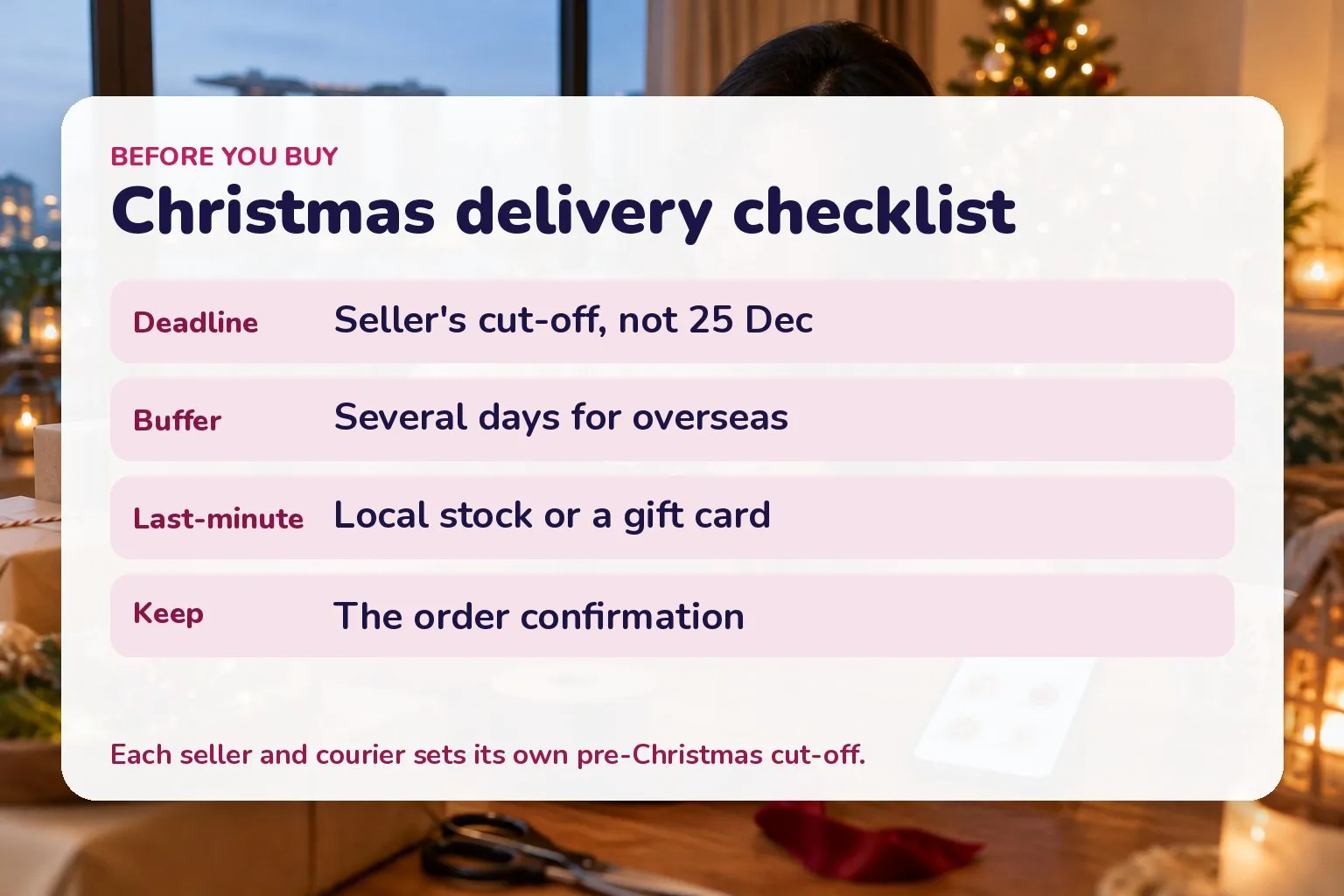
A quick checklist for getting gifts delivered in time.
A few habits keep you ahead of it:
- Treat the courier’s stated cut-off as your deadline, not Christmas Day itself. Each seller and logistics provider sets its own “order by” date for pre-Christmas delivery; check it on the listing or at checkout before you buy.
- Order time-sensitive gifts first and leave a buffer of several days, especially for anything shipped from overseas.
- Prefer local stock or official stores for last-minute buys — a local warehouse is far more predictable in the final week than a cross-border parcel.
- Keep the order confirmation; you will want it if a parcel is late, lost or the item has to go back.
If you have left a physical gift too late, a gift card or an e-voucher is the honest fallback — delivered instantly and still something the recipient chose for themselves.
GST on gifts bought from overseas
Christmas pulls in a lot of cross-border buying — a specific toy, a brand not sold locally, a cheaper overseas listing. Before you compare an overseas “deal” with a local one, add the tax.
Since 1 January 2024 the prevailing GST rate has been 9%. For imported low-value goods — each item with a sales value of S$400 or less, brought into Singapore by air or post from a GST-registered supplier or marketplace — IRAS requires GST to be charged at the point of purchase, normally shown at checkout. The S$400 “sales value” test excludes separately stated shipping and insurance: in IRAS’s own example, a S$420 dress with a clearly separate S$25 delivery charge has a sales value of S$395, so it is caught and GST applies.
Returns and your rights on gifts
This is the part of Christmas shopping most people get wrong. In Singapore there is no automatic legal right to return or exchange an item simply because you — or the person you gave it to — changed your mind. “Change of mind” returns are a goodwill policy some retailers offer, not a legal entitlement, so the window and conditions are whatever that seller sets. If you are buying a gift, check the seller’s return and exchange policy before you pay, and keep the receipt or order record with the gift.
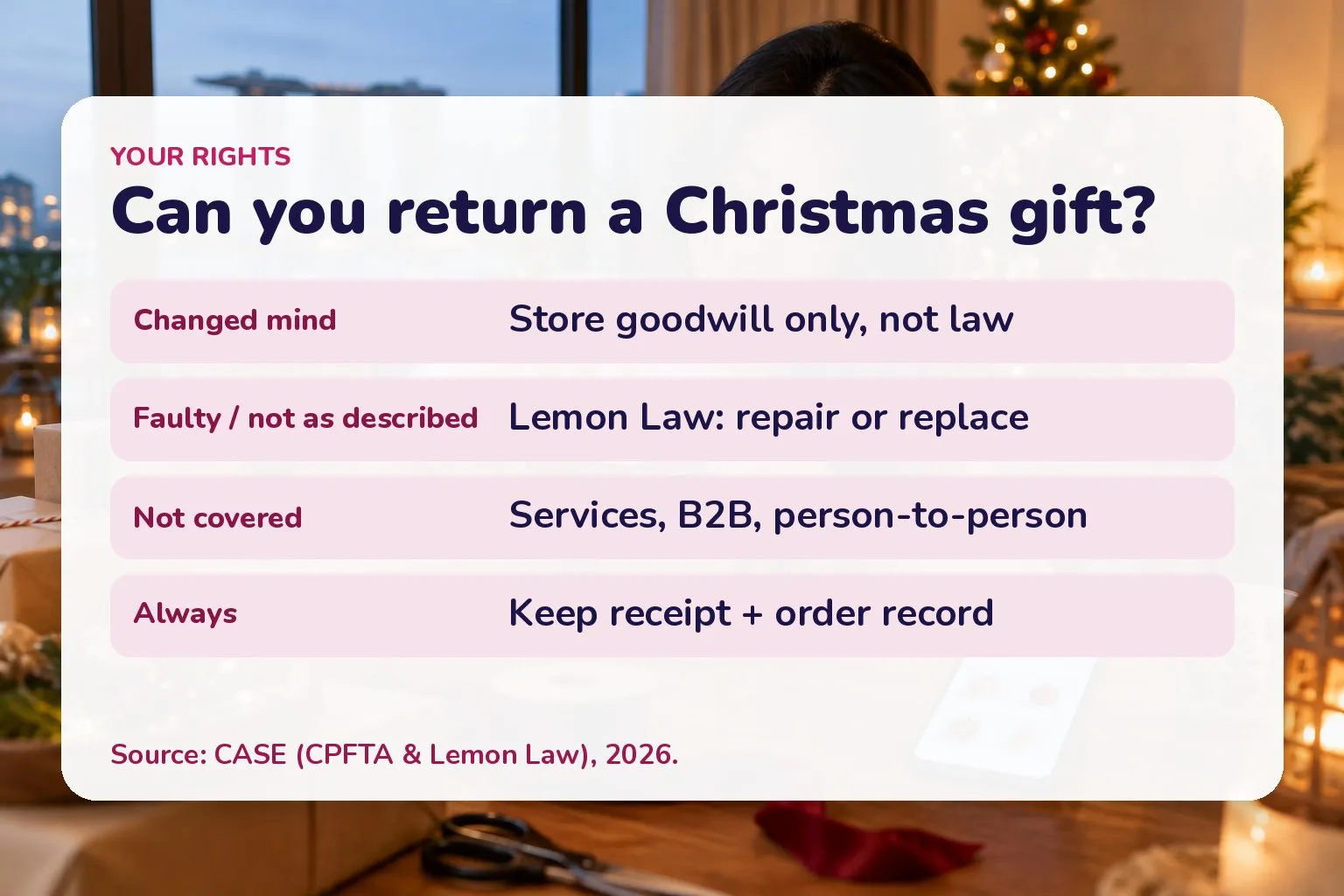
What you can and cannot do with an unwanted or faulty gift.
Where the law does step in is when a gift is faulty or not as described. Singapore’s Lemon Law — Sections 13 to 18 of the Consumer Protection (Fair Trading) Act, administered by CCCS, with CASE the first point of contact for consumers — lets you ask for a repair or replacement first, with a price reduction or refund if that cannot be done appropriately or within a reasonable time. It covers general consumer goods bought in Singapore (electronics, apparel, toys, furniture and so on), including second-hand goods, but not services, and not business-to-business or person-to-person sales.
Spotting a genuine Christmas discount
A big strike-through price is persuasive, but it only means something if the “usual price” behind it is genuine. Singapore’s Competition and Consumer Commission (CCCS) published its Guidelines on Price Transparency, in effect since 1 November 2020, setting out how the Consumer Protection (Fair Trading) Act applies to price displays and comparisons. When a supplier shows a discount or compares against a “usual” price, CCCS says they “should ensure the discount or price benefit offered is genuine and provide a valid basis for the discount or comparison, so that consumers are not misled”. Time-limited offers should also have their period stated clearly, and mandatory charges such as taxes should be reflected in the headline price rather than sprung at the end.
In practice, that leaves you a short checklist:
- Know the usual price before December. Note what the item sells for in November so a festive “before” figure cannot fool you.
- Ignore the countdown pressure. A genuinely good price survives a five-minute pause while you compare.
- Compare the same item across Shopee and Lazada, with vouchers and shipping counted — see Shopee vs Lazada: where are deals better.
- Be sceptical of a “before” price that jumped up just before the campaign.
For the full method, see how to spot fake discounts, and for what our own records can and cannot tell you, read how our price tracking works.
The bottom line
Christmas shopping in Singapore rewards planning over speed. The real deals are the everyday gift categories running year-end promotions — not the festive lines that tend to rise on demand — so know the usual price, claim your vouchers, and compare before you commit. Then let logistics, not the discount, set your deadline: order early, respect each seller’s cut-off, and keep the receipt in case a gift has to come back. If you want to understand how December stacks up against the year’s biggest sale, read 11.11 vs 12.12: which sale is better. And to see how a site like this earns from shopping links without bending the advice, see how we make money and keep prices honest.
Affiliate disclosure: Some links on this page are affiliate links. If you apply or buy through them we may earn a commission at no extra cost to you. This never changes the rates, figures or comparisons shown — those come from official or vendor sources with an "as of" date. We do not recommend specific products.
Sources
- CCCS Publishes Guidelines on Price Transparency — Competition and Consumer Commission of Singapore (as of October 2026)
- GST on Imported Low-Value Goods — Inland Revenue Authority of Singapore (as of October 2026)
- Prevailing GST rate — Inland Revenue Authority of Singapore (as of October 2026)
- CPFTA & Lemon Law — Consumers Association of Singapore (CASE) (as of October 2026)
- 11.11 Big Sale — Shopee Singapore (as of October 2026)