Best Laptop Deals in Singapore: How to Choose and What's a Real Deal

For students and everyday work the best-value buy is the Asus Vivobook 14, often about S$999 on offer with a Core i5-class chip, 16GB RAM and a 512GB SSD. Step up to a Copilot+ Vivobook 14 (about S$1,499) for a newer AI chip.
On this page13 sections · tap to jump
Laptops are the headline act of every Singapore mega-sale, and the strike-through prices make it easy to overpay for power a student or office worker never uses. This guide names the best buys by use-case, compares the trims on published specs and Asus’s own Singapore prices, and shows how to judge the discount. Prices are approximate, as of 30 October 2026, read from the brand’s own Singapore store; the “special” prices are promotional and sit against a listed regular price, so confirm the cash price at checkout.
Quick verdict
The Vivobook 14 wins for most buyers because it covers the jobs people actually do — browsing, documents, lectures, light photo work — with 16GB of RAM and a fast SSD, at the lowest sensible price for a laptop that will last. Step up to a Copilot+ chip, an OLED screen or a Mac only when you specifically want what they add.
How the picks compare
The sweet spot for study and office work sits between roughly S$1,000 and S$1,500, with OLED and creator trims above. Representative current prices from Asus’s Singapore store:
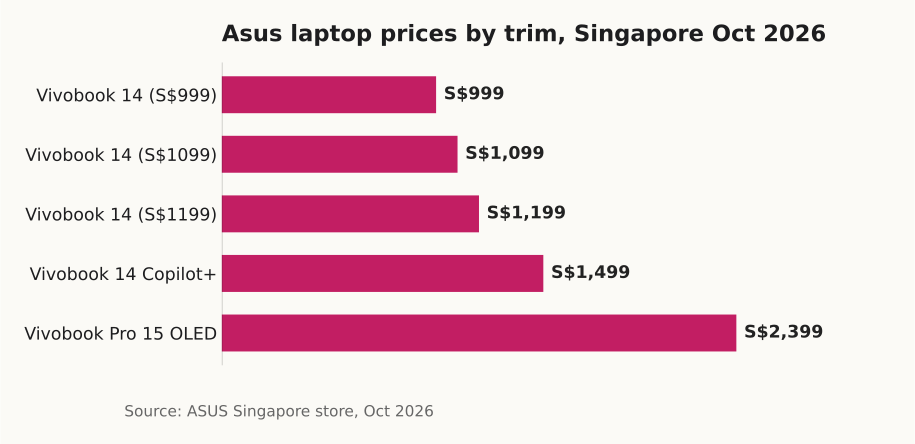
Approximate Asus Singapore laptop prices by trim, late Oct 2026 (promo prices).
| Laptop (Asus) | Chip | RAM / SSD | Screen | Approx. price | Usual |
|---|---|---|---|---|---|
| Vivobook 14 (M1405NAQ) | Ryzen / Core i5 class | 16GB / 512GB | 14” FHD | ~S$999 | S$1,299 |
| Vivobook 14 (X1405VA) | Core i5 class | 16GB / 512GB | 14” FHD | ~S$1,099 | — |
| Vivobook 14 (X1407QA) | Intel/Snapdragon | 16GB / 512GB | 14” | ~S$1,199 | S$1,599 |
| Vivobook 14 (X1407CA) | Intel Core Ultra 5 | Copilot+ PC | 14” | ~S$1,499 | S$1,799 |
| Vivobook Pro 15 OLED | creator-class | OLED | 15.6” OLED | ~S$2,399 | S$2,699 |
| Zenbook A14 | Ultra / Arm | ultralight | 14” | ~S$3,699 | — |
Ranking is on published specs and brand-store price only — not independent benchmarks. Chip generations and exact trims change between campaigns, so match the configuration (CPU, RAM, SSD, screen) rather than the model name alone. Acer’s Aspire 14 line sells at broadly similar prices and is worth cross-shopping for the same specs.
Best value for study and everyday work
For lectures, assignments, browsing, documents and light editing, the Asus Vivobook 14 is the pick, with trims from about S$999 (on offer, regular S$1,299) through S$1,099 and S$1,199 (regular S$1,599). The core specs that matter are consistent across the range: a modern Core i5-class or Ryzen chip, 16GB of RAM and a 512GB SSD, in a roughly 1.5kg 14-inch chassis that slips into a bag. That is enough for comfortable multitasking, video calls and the occasional photo edit — the things most students and office workers actually do.
Step up: Copilot+ and OLED picks
Two upgrades are worth considering once your budget passes S$1,500. A newer “Copilot+” AI chip — with an on-device neural engine for Windows AI features — comes on the Vivobook 14 (Intel Core Ultra 5) at about S$1,499 (regular S$1,799). Separately, an OLED screen (deep blacks, vivid colour, easier on the eyes for long sessions and photo work) steps up to the Vivobook Pro 15 OLED at about S$2,399 (regular S$2,699), a 15.6-inch creator-class machine. Some Copilot+ laptops across the market use Qualcomm’s Arm-based Snapdragon X instead of Intel or AMD.
If you want macOS
Apple’s Singapore line-up runs from the MacBook Neo (“the magic of Mac at a surprising price”) up through the MacBook Air (M5) in 13-inch and 15-inch sizes to the MacBook Pro. The Air is the natural student and everyday choice: silent, fanless, light and long-lasting on battery. We don’t quote an Apple laptop price here because the live figure didn’t render on our check — look it up on Apple’s Singapore store, and if you’re a student or teacher use the Education Store for a lower price. Every Mac carries a one-year limited warranty, and AppleCare+ extends cover to three years with accidental-damage fees of S$138 for screen damage or S$428 for other damage.
What specs matter
Ignore most of the spec sheet and weight four things. RAM: 16GB is the floor for a machine you keep several years; 8GB feels tight fast. Storage: a 512GB SSD is the comfortable default; 256GB fills quickly. Screen: a 14-inch 1080p (WUXGA) IPS panel is fine for work; OLED is a genuine upgrade if you watch a lot or edit photos. Weight and battery: under ~1.5kg and an all-day battery matter if you carry it daily. Chip generation matters least for everyday tasks — any current Core i5/Ryzen 5-class or better is enough.
When to buy
Laptops are promoted hard around the double-digit sales — 9.9, 10.10, 11.11 and 12.12 — plus Black Friday, year-end and the mid-year PC and IT shows. These windows recur through the year, so patience pays. Because this is a higher-value purchase, it is worth tracking the exact model for a week or two first. See best time to buy electronics for the full calendar.
Is the discount real?
A laptop marked down from S$1,799 to S$1,499 looks dramatic, but strike-throughs are routine here, so judge the cash price, not the badge. The CCCS Guidelines on Price Transparency, in force since 1 November 2020, say a discount or “usual price” comparison must be a genuine price benefit with a valid basis, that sellers should not inflate prices before discounting, and that a time-limited offer must state its period clearly.
- Note the usual price across the brand’s own store and two or three sellers before the campaign.
- Compare the exact configuration (CPU, RAM, SSD, screen) on Shopee and Lazada, with vouchers and shipping added — see Shopee vs Lazada.
- Benchmark against the brand store price above; the regular price shown there is the honest “before” figure, not the seller’s inflated tag.
- Check our price tracking for whether the current figure is below the typical recorded level.
GST on an imported laptop
Most laptops cost well over S$400, so the low-value-goods rule rarely helps you. Under IRAS rules, the 9% GST (the rate since 1 January 2024) point-of-purchase scheme applies only when an imported item’s sales value is S$400 or less from a GST-registered seller. A laptop above S$400 bought from an overseas seller instead has GST collected at the border on its full value if the seller is not GST-registered — on top of any shipping — and servicing a grey import can be hard. A local set with a Singapore warranty is usually the safer buy.
If it arrives faulty
Who should skip the winner
The Asus Vivobook 14 is the wrong buy if you want a premium OLED screen (step up to the Vivobook Pro 15 OLED or cross-shop an OLED Acer Aspire), the longest battery life in the lightest body (an Arm Copilot+ machine, if your apps are mainstream), or the macOS ecosystem (a MacBook Air). It is also under-powered for serious gaming, 3D or heavy video work, which need a discrete-GPU or creator laptop well above this budget. And committed Apple users who already run an iPhone and iPad will get more from a MacBook.
Common questions
How much RAM and storage do I really need? 16GB RAM and a 512GB SSD for a laptop you keep several years. Drop to 8GB/256GB only for the lightest, most occasional use.
Is an Arm Copilot+ laptop safe to buy? Yes if your software is mainstream (browser, Office, streaming); battery life is excellent. Avoid it if you depend on older or specialist Windows programs.
Should I wait for a sale? If the current cash price for the exact configuration is clearly below the brand’s own store price and the typical tracked level, buy. Otherwise wait — campaigns recur through the year.
The bottom line
Match the laptop to how you’ll use it: the Asus Vivobook 14 at around S$999 for most students and office work, a Copilot+ chip or OLED screen when you specifically want them, and a MacBook Air for the Apple ecosystem. Then buy during a sale only when the cash price for your exact configuration is clearly below the official store price. For the full price-check method see how to spot fake discounts, and for the other big-ticket device this season see best tablet deals.
Affiliate disclosure: Some links on this page are affiliate links. If you apply or buy through them we may earn a commission at no extra cost to you. This never changes the rates, figures or comparisons shown — those come from official or vendor sources with an "as of" date. We do not recommend specific products.
Sources
- ASUS Vivobook laptops (Singapore store) — ASUS Singapore Store (as of October 2026)
- ASUS Vivobook 14 X1407 (Singapore store) — ASUS Singapore Store (as of October 2026)
- Buy Mac (MacBook line-up) — Apple Singapore (as of October 2026)
- GST on Imported Low-Value Goods — Inland Revenue Authority of Singapore (as of October 2026)
- GST Rate Change (8% to 9% from 1 Jan 2024) — Inland Revenue Authority of Singapore (as of October 2026)
- CCCS Publishes Guidelines on Price Transparency — Competition and Consumer Commission of Singapore (as of October 2026)
- CPFTA & Lemon Law — Consumers Association of Singapore (CASE) (as of October 2026)
- Refunds and Return Policy — Shopee Singapore (as of October 2026)